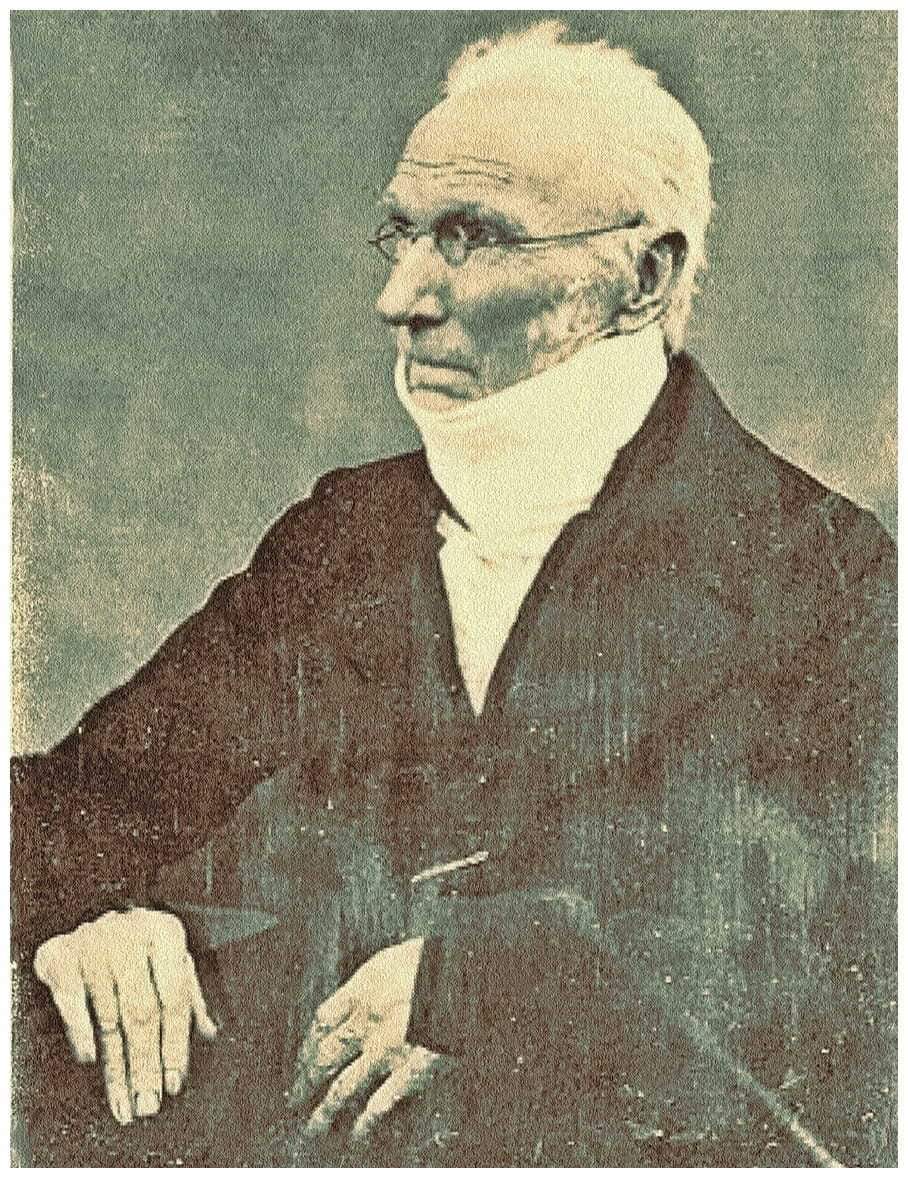
Patrick Brontë (1777-1861) was the father of Branwell, Charlotte, Emily and Anne. Apparently, his daughters weren’t the only ones in the family to be gifted authors as Patrick also enjoyed writing.
He wrote two small volumes of poetry and two short stories; one a tale of Irish life and the other entitled “The Art of Becoming Rich and Happy”.
But did you know that he had a connection to Ossett?
During his tenure as curate at Dewsbury from 1809 to 1811, he officiated at numerous weddings, baptisms, and funerals of many residents of Ossett, all of which took place at Dewsbury Parish Church.
One such wedding was that of an Ossett couple – James Oldroyd and Maria Dews who, with their children, eventually emigrated to America.
Their grandchildren sold James and Maria’s marriage certificate, which was written by Patrick Brontë. It realised $7,000!
A plan of Flushdyke dated 1771. Click to enlarge it.
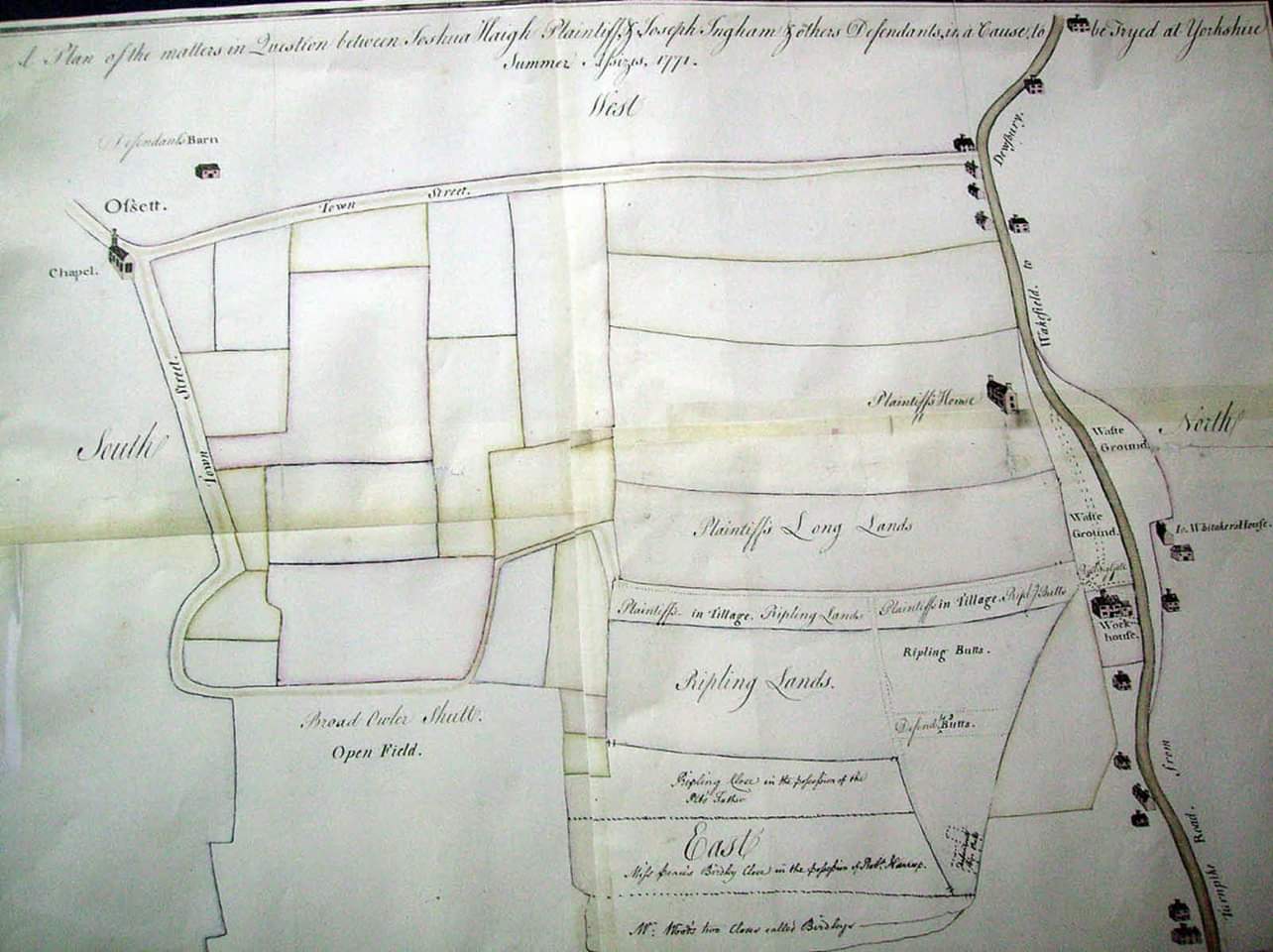
Look how close Haigh’s Longlands was to the Workhouse. From the richest to the poorest in a few hundred steps. Just across the way is Whitaker’s House. I like the bit with the Chapel on it. Long since demolished, this is the site of the original Holy Trinity and it stood in the Market Place, about where the War Memorial is now. This was also the site of the Pickard Memorial Fountain.
I like the bit with the Chapel on it. It is important to acknowledge that the original Holy Trinity, once occupied this site in the Market Place. In its place now stands the War Memorial, a poignant reminder of sacrifice and remembrance. Equally notable is the Pickard Memorial Fountain, which also stood on this (approximate) site before being removed in 1958.
I wonder what the dispute was about….
Notably, one of the defendants involved in the case was Joseph Ingham. The Ingham family holds a longstanding presence in Ossett, with historical records tracing their lineage back to the time of the English Civil War. Among the earliest recorded Ossett Inghams is William Ingham (1615-1670), who held occupations as a felt maker, yeoman, and prominent landowner in the area.

and Ossett Through The Ages (OTTA)
Descended from this same Ossett family are the Joshua Inghams of Blake Hall, and the third Joshua Ingham of this line (1802-1866) was to employ Anne Brontë. She wrote the partly biographical novel ‘Agnes Grey‘ in 1847, describing her somewhat difficult time at Blake Hall as a governess to the Inghams’ two eldest children, Cunliffe and Mary. Master Tom, the brat-from-hell, was actually (Joshua) Cunliffe Ingham, and his precocious sister, Miss Mary Ann, was really his younger sibling Mary Ingham. In the novel, Blake Hall became Wellwood House, and the Inghams became the Bloomfields. However, the Inghams, dissatisfied with their children’s progress, dismissed Anne Brontë within a year. The Brontës were also regular visitors to Longlands House at Flushdyke.
Born in 1797, Elizabeth Firth was the godmother of Anne Brontë, who was born in 1820 in Thornton, Bradford, where Elizabeth lived. Patrick Brontë became the curate in the village in 1815, and Elizabeth soon became great friends with him and his wife, Maria. Five years later, the Brontës moved to Haworth where, when Anne was just a year old, her mother, Maria, died of uterine cancer.
Patrick Brontë had spent large sums of money on medical care for his dying wife and incurred significant debts in the process. Elizabeth Firth was among the friends who helped clear his debts.
In December 1821 Patrick Brontë proposed marriage to Elizabeth Firth but she declined his offer.
Elizabeth made further contributions throughout the lives of all the Brontës, regularly sending them gifts. She also paid for the eldest Brontë daughters to attend the exclusive Crofton Hall School, where she herself had attended. The hall, which was built by Joshua Wilson (1706-1778) of Pontefract, was demolished in 1981.
From the age of fifteen, Elizabeth Firth kept a diary, detailing her daily activities. From 1815 onwards, her diary became filled with entries about the Brontës. For example, on November 6, 1817, she wrote, “I went to Bradford with Mr Brontë. The Princess Charlotte of Wales died.”
These diaries have survived, and while they don’t go into too much detail, they do show the relationship between the Firth and Brontë families. Included in Elizabeth’s diaries are her visits to Ossett, and particularly Longlands, the home of the Haigh family.
6 Apr Miss Clarke married Mr Charles Stokes. I dined at Longlands
18 Apr We came to Longlands
24 Apr Miss Outhwaite came to Longlands
29 Apr We walked to Gawthrop
1 May We drank tea at Low Laithes
3 May Called at Low Laithes
10 May We called at Low Laithes. Mr & Mrs Kilvington called here
13 May My Papa and Mr Bronte went to Wakefield to vote for Mr Scott. Stopped all night at Longlands. (The election was for a registrar for the West Riding. Scott, the Tory candidate, withdrew on the following Friday when it became clear he could not win.)
25 Aug Went to Longlands
7 Sep Miss Hannah Haigh came
9 Sep Mr Joshua Haigh came
19 Sep Came to Longlands. Doctor and Miss Alexander came to tea.
20 Sep Mrs Nettleton and Mr Wheatley to dinner
26 Sept My Papa came for me to go to Longlands at ten in the morning. My Mama was there.
13 Dec My Papa and I went to Longlands
14 Dec Mr Walker dined at Mr Haigh’s
Elizabeth Firth’s diaries have been preserved, and are now in the Sheffield University archives. A transcription of the diaries can also be read online.
Regency Reads
In 1688, John Haigh of Thornhill purchased land at Longlands, which remained in the Haigh family until 1857 when Ann, the last of the five Misses Haigh, passed away. The estate was then inherited by Charles Wheatley, a cousin of the Misses Haigh, who subsequently rented out the property. Upon his death in 1900, Charles left Longlands to his cousin Eleanor Steele. Eleanor passed away ten years later, leaving Longlands to her son and three daughters.
In 1929, Mr. Crook bought Longlands and in 1969 he sold three acres to Milner Development Ltd for industrial development. In 1971, Mr. Crook died and the hall and remaining land were purchased by Milner Development Ltd. Longlands was demolished shortly after.

Photo: Ruth Nettleton
One of the Brave
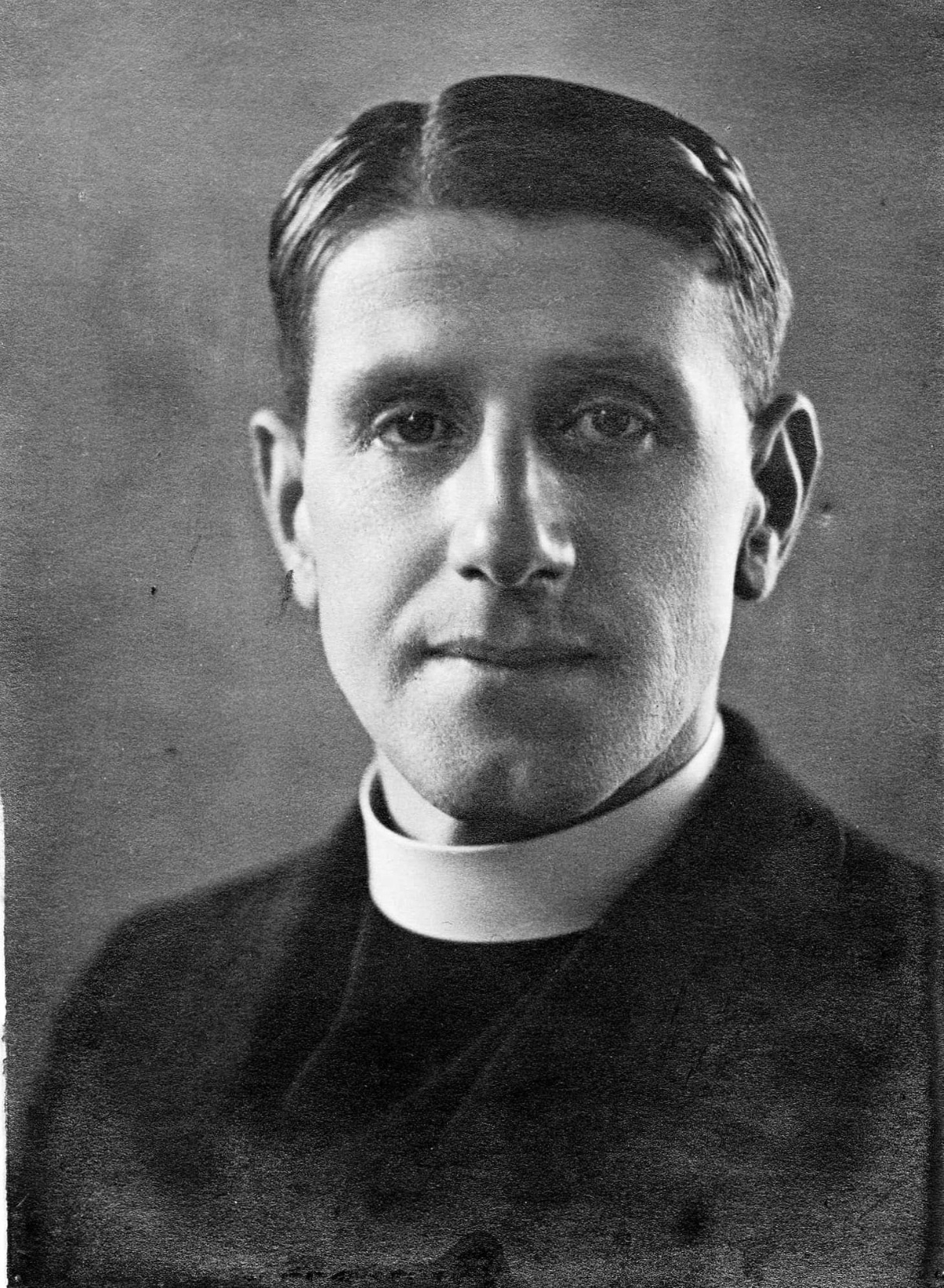
Hugh Noel Conway Davies was the curate of Holy Trinity Church from 1933 to 1936. His role would have been to support the vicar who, at that time, was Rev George Herbert Marshall DSO., the chaplain who officiated at the funeral of the Red Baron.
Hugh, who was known as Noel, was born in Llanfynydd, Flintshire in December 1892. Noel’s father was Rev William Taliesin Davies, a clergyman from Caernarvon. Noel’s mother, 37 year old Marie, passed away eighteen months later, just a few weeks after the birth of her sixth child. Maria’s cousin, Martha Garlick, moved into The Rectory in Llanfynydd to care for the young, grieving family.
The 1911 census shows that, by the age of 18, Noel was a student at Kelham Hall in Nottingham which, for 70 years, became home to an Anglican order of monks, gaining its impressive domed chapel. Originally this was where the Society of the Sacred Mission prepared students for missionary service. When Noel attended the college they trained clergy for the Church of England. Noel went on to study medicine at Liverpool University.
By September 1 1915 Noel was serving in France as Private HNC Davies 3856, 12th Battalion Royal Fusiliers. He rose to the rank of Corporal and was next attached to the 29th Battalion London Regiment. Serving as a doctor’s medical assistant, Noel was in charge of 30 stretcher bearers. These brave men went over the tops of the trenches unarmed, carrying a stretcher and medical supplies.

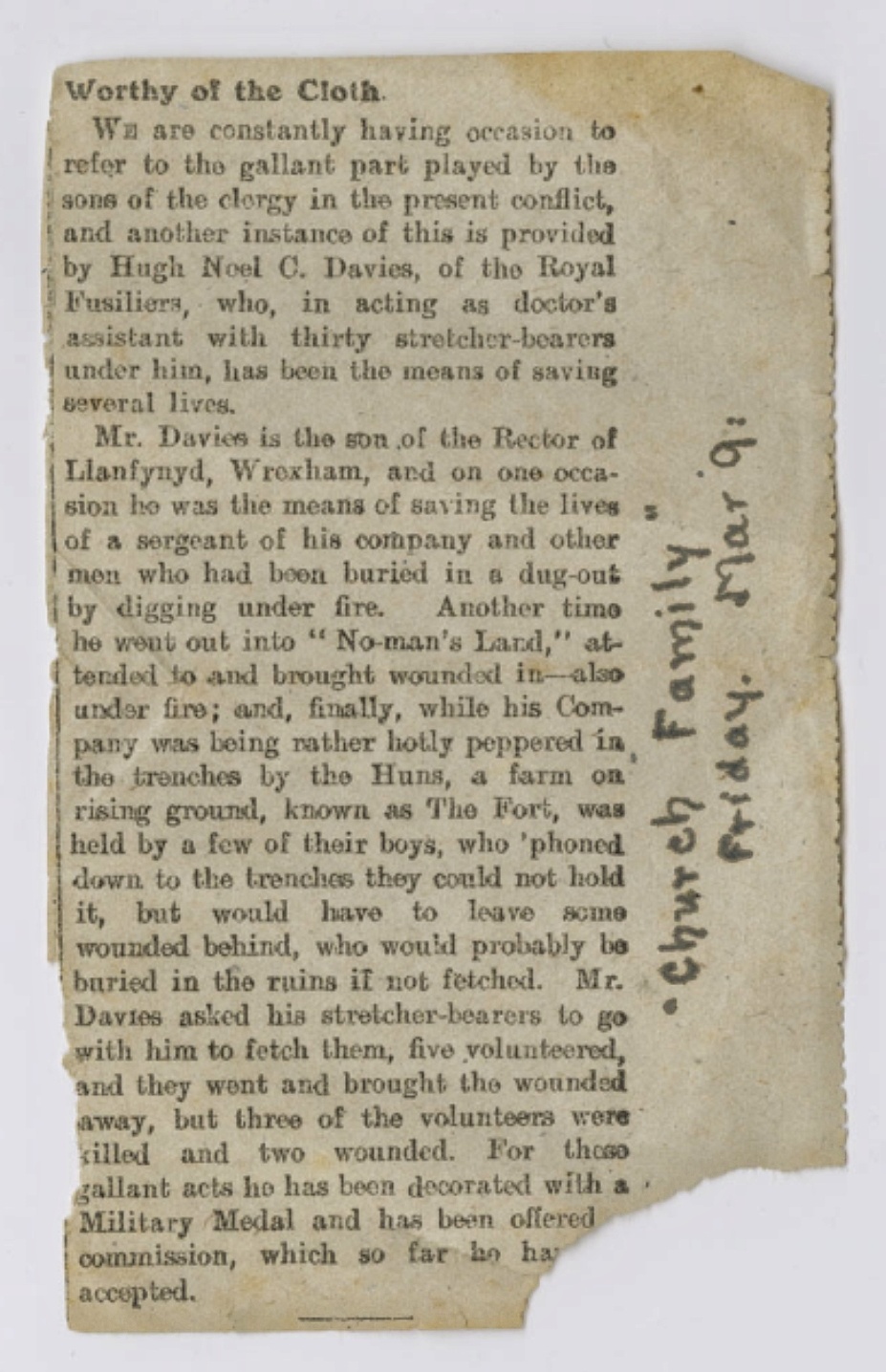
The Church Family newspaper of Friday 9 March 1917 reported how Noel had been awarded the Military Medal + bar. Instituted in March 1916, this medal was awarded to non-commissioned officers (NCOs) and men of the British Army for acts of bravery during World War I. The addition of the bar indicates a further act of bravery.
On one occasion Noel was responsible for saving the life of a sergeant and several other men of his Company who had been buried in their dug out; digging them out whilst under enemy fire. Another time he went out into “No Man’s Land” and attended to the wounded, bringing them in whilst again under fire. Finally, while his Company was under fire in the trenches, a call came in to say some of their men were struggling to keep hold of a vantage point. They had to move or suffer the consequences but to do so meant leaving behind their wounded. Noel asked for volunteers to help him to bring them back and five went with him and brought them away. Three of those who volunteered were wounded and two were killed. Not only was Noel awarded the Military Medal but he was also offered a commission which he refused. One can only imagine the pain he must have felt at the loss of the lives of those men who volunteered on his request.
As far as I can tell, the record of Noel’s military service has not survived. About 60% of service records were damaged or destroyed in September 1940 when the War Office in London was bombed. I have managed to find Noel on the Medal Rolls Index and the Service Medal & Award Rolls. He was awarded the Victory & British Medals and the 1914-15 Star. Worn together, these medals became known as “Pip, Squeak and Wilfred”.
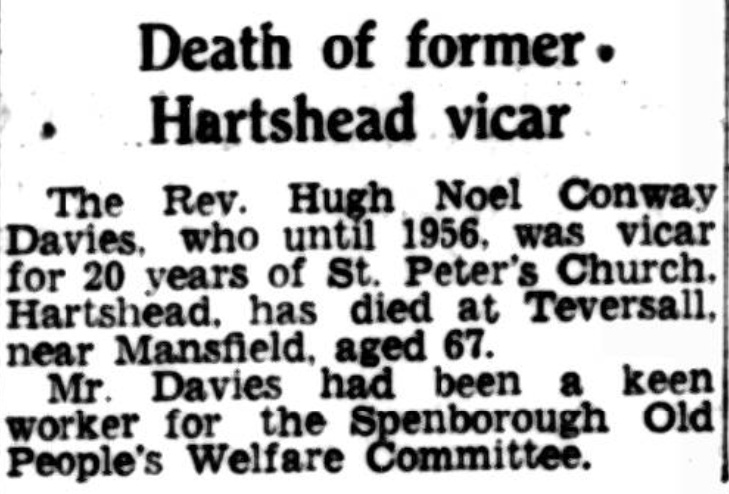
In 1924 Noel married Ruby Williams in Pembroke and by 1932 they had arrived in Yorkshire. Noel was ordained as a deacon at Wakefield Cathedral in May 1932 and in June the following year he was ordained as a priest. In January 1936 he left Ossett having accepted the living at St Peter’s at Hartshead where he stayed for the next 20 years.
Noel had a deep interest in history and recorded the history of St Peter’s Church and its links with the Brontës. Reverend Patrick Brontë, father of the famous literary sisters, was incumbent at St Peter’s between 1810 and 1815. Rev Brontë was also incumbent at Dewsbury Parish Church, giving him a connection to Ossett as many of our townsfolk were christened, married or buried there by him.
Halifax Evening Courier
Noel also made recordings of the history of Robin Hood and this was even broadcast in America. It is said by some that Robin Hood cut his last arrows from a yew tree in the churchyard of St Peter’s, the dead trunk of which can still be seen standing there today.
In 1956 Noel left Yorkshire when he became the Vicar of St Katherine’s in Teversal, Nottingham. He died in 1959 and is buried in the churchyard there.
WE WILL REMEMBER THEM
If you’ve found this of interest, do please consider contributing to the running costs of this website. Any amount would be greatly appreciated. Thank you.
Please click on the PayPal button below. You don’t need a PayPal account to help out. Many thanks.

 HORBURY & OSSETT FAMILY & LOCAL HISTORY