
Photo: Jonathan Gawthorpe July 7 2023.
Yorkshire Post
Ossett July 2023
The service medals of two brothers from Lancashire who served in WW1 have unexpectedly surfaced for sale in a shop in Ossett. Despite the brothers, Arnold and Peter Booth, not having any apparent connection to the town, I felt compelled to do all I could to try and locate any family that might wish to acquire their medals. Thank you to my good friend Wendy Farrar for bringing the medals to my attention. The following is how I located the Booths and a little of their family history. It is very much a work in progress. If you have any other information about this family, or corrections, I’d love to hear from you.
📧 horburyandossettfamilyhistory@gmail.com
Wendy shared with me a Facebook video about the five prestigious service medals. Watching it left me feeling inspired and determined to gather as much information about them as possible. From the video I was able to retrieve limited details, such as the names ‘P Booth’ and ‘A Booth‘, their regiments – the East Lancashire Regiment and the Manchester Regiment, and a lead about their mother in Morecambe. Embarking on this journey of family history and military research, I was determined to do all I could to uncover the remarkable stories behind these brave men!
I began my search and, although it wasn’t unexpected, I was dismayed to find several soldiers named ‘A Booth‘. There were three from the Manchester Regiment alone … I needed to narrow it down. I eventually found a pension record for ‘Arthur Booth‘ and it provided me with his service number and two addresses – one of which was that of his mother in Morecambe and the other an address for his grandmother (that came in useful later). As the pieces of the puzzle were starting to fall into place, I felt a renewed sense of optimism.
I successfully located ‘Arnold Booth’ in the 1891 census, matching his address closely enough with that of his grandmother mentioned in his WW1 pension record. Fortunately, Arnold was born before the census was conducted, ensuring that vital information about his whereabouts at that time was captured. Had he been born after the census was recorded then I may have never found him! Further investigation led me to Arnold’s Baptism Record, confirming the same address and adding more pieces to the puzzle. The family had relocated by the time of the 1901 census, in which I was able to identify Arnold, his parents, and his siblings – including his brother ‘Peter Booth’. Through further research, I discovered a public family tree that allowed me to establish contact with direct descendants of the Booth brothers. Subsequently, James Brocklehurst, the seller at Ossett Antiques & Collectibles, was contacted and it was at James’s shop that I had the privilege of meeting the widow of Peter Booth’s youngest son, along with two of his grandsons and his great-granddaughter. I extend my gratitude to Kay Booth for trusting in me!


ITN, The Yorkshire Post and BBC Radio Leeds all came to Ossett to cover the story. Read it here.
Across the Pennines
Jane Holt (1873-1953) and Amos Booth (1870-1921) were married in the Bury district in the winter of 1890. I suspect that they were married at Unsworth North Wesleyan Methodist Church, close to 288 Hollins Lane, Unsworth where they lived with Jane’s widowed mother: Mary Alice Holt (née Whiteside).
Jane and Amos had seven children. Five sons and a daughter survived into adulthood but one child died prior to the family being recorded on the 1911 census. The eight year gap between the birth of Peter in 1899 and Florence in 1907 indicates that this child was probably born sometime during that period.
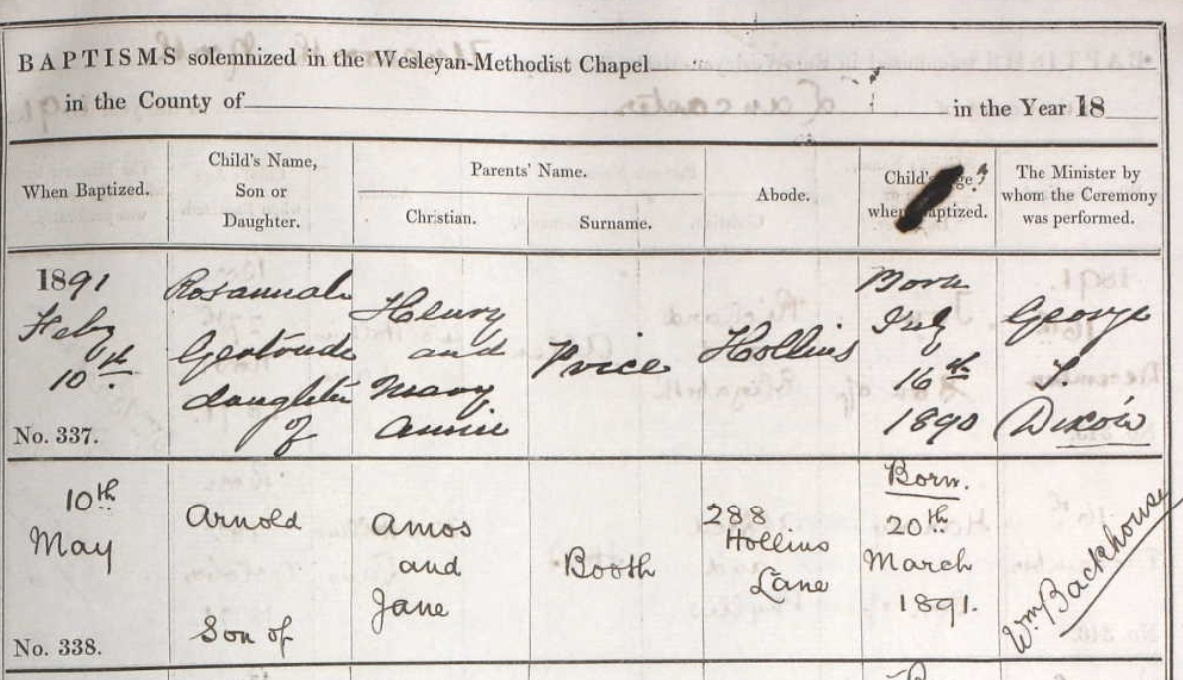
● Arnold Booth was born at Whitefield on March 20 1891 and was baptised on May 10 1891 at Unsworth North Wesleyan Methodist Church. The address on his Baptism Record is ‘288 Hollins Lane, Hollins‘ (the home of his maternal grandmother).
● Arthur Booth was born at Whitefield on June 13 1894 and was baptised on July 11 1894 at Unsworth North Wesleyan Methodist Church. The address on his Baptism Record is ‘Prospect Place, Hollins’.
● Handel Booth was born at Whitefield on November 16 1895 and was baptised on January 8 1896 at Unsworth North Wesleyan Methodist Church. The address on his Baptism Record is ‘Hollins‘.
● Peter Booth was born at Whitefield on March 26 1899. (This information is from the 1901 census and the 1939 Register). I’ve been unable to locate an online record of Peter’s baptism but i did learn that his birth was registered in March 1899 in the England & Wales Civil Registration Birth Index. As all his siblings were baptised there, I suppose that Peter too was baptised at the Unsworth North Wesleyan Methodist Church.
● Florence Booth was born at Droylsden on January 11 1907 and was baptised on March 31 1907 at Unsworth North Wesleyan Methodist Church. The address on her Baptism Record is ‘16 Oldham Street, Droylsden‘.
● Alfred Booth was born in Droylsden in October 1912 and his birth was registered in Ashton Under Lyne. I’ve not been able to locate his Baptism Record but Droylsden is included in the district of Ashton Under Lyne.
During World War I, four out of the five brothers bravely served their country.
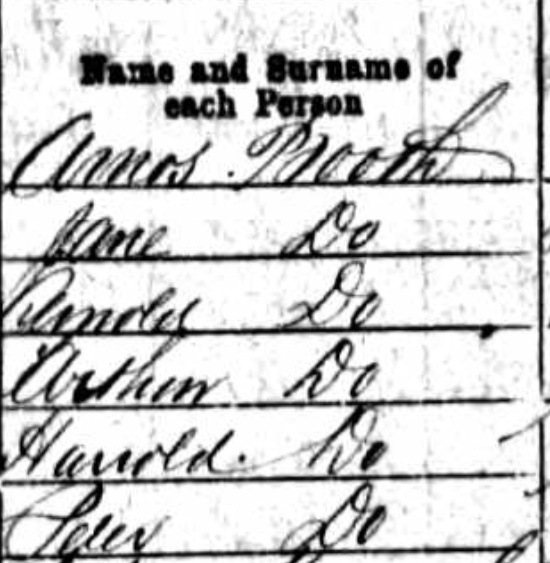
By 1901, the Booths lived at Holly Grove, Hopper Lane, Droylsden. The 1901 census shows ‘Handel Booth’ incorrectly recorded as ‘Harrold’. I hope this may help others researching this family.
Amos Booth faced a summons in the Ashton County Police Court in September 1909 when his wife, Jane, insisted on him being charged with desertion.
Amos had a dispute with his eldest son, Arnold, and subsequently left the family home two months prior to receiving a court summons. Jane Booth, his wife of 19 years, confirmed that Amos had made no financial contributions towards the care and support of her and their five younger children, aged between 11 and two. It should be noted that during this period, their deceased child was still alive.
During the court proceedings, Jane testified that Amos had made a serious threat to harm Arnold, expressing intentions of inflicting physical harm and evicting him from their home. Amos shared his side of the story, revealing that he had chosen to leave after Arnold displayed disrespectful behavior towards him.
Additionally, Amos informed the court about his prolonged illness with bronchitis, which lasted for 17 weeks. Unable to continue working at the bleach factory, where he packed cloth, Amos had to resign from his position. Despite attempts to establish a small business in Droylsden, it ultimately failed, leading him to return to his former employment. In his testimony, Amos expressed how his wife had neglected him during his illness, merely sending food to his room and leaving him to fend for himself.
Amos resolved not to return to his wife. As a result of the court proceedings, he was ordered to provide Jane with a maintenance payment of 7 shillings and 6 pence from his weekly earnings, which ranged between 30 shillings and £2.
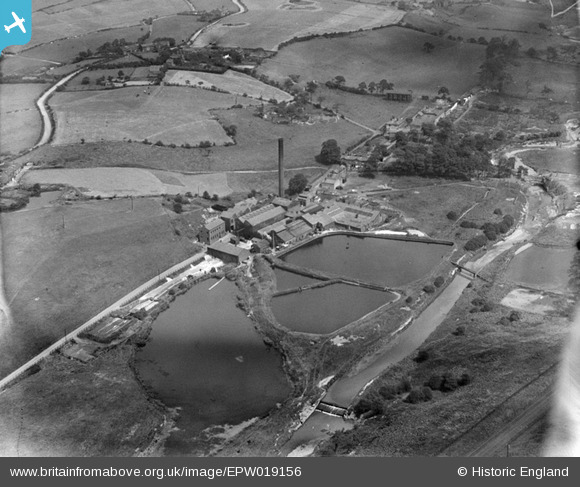
It’s not entirely clear when Amos made his return to the family home, but he was recorded there on the night of the 1911 census. At the time, Amos earned a living as a cloth packer in a bleach factory called Medlock Vale Bleach Works, situated in Clayton Bridge. Interestingly, his 20-year-old son Arnold also worked alongside him, which could hint at a reconciliation between father and son. As for the rest of the family, the household included 16-year-old Arthur, busy as a parceler at a chemist manufactory, and 15-year-old Handel, who worked as a spinner in a nearby mill. Meanwhile, the youngest children were still attending school.
Jane Booth was recorded as a ‘grocer/shopkeeper’ and took charge of her own business. It’s fascinating to think about her entrepreneurial spirit and her determination to make a living on her own terms. The 1911 census enumerators summary books reveal that the Booth’s four roomed home at 146 Moorside Street, Droylsden also included Jane’s shop.
In later years, her daughter Florence pursued a career as a confectioner, crafting sweets and chocolates. It is quite possible that Florence inherited her mother’s talent and knowledge, creating a sweet legacy with her own unique touch.
War Time
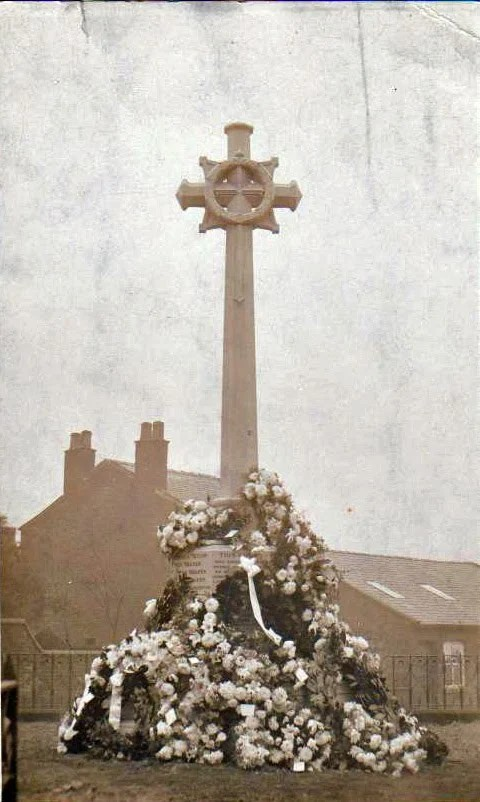
The Unsworth Pole War Memorial stands at the junction of Pole Lane and Sunnybank Road, Unsworth. Taking the form of a cross on a shaft, the memorial stands on a two-stepped octagonal base.
There are 55 casualties commemorated from WW1 and three casualties from WW2.
Among them is Arnold Booth:- the eldest son of Jane and Amos Booth.

Private Arnold Booth, 2614, 1st/8th Bn., Manchester Regiment was a Territorial and as such was not obliged to serve overseas. Arnold’s service record appears to have not survived but I did locate his Medal Index Card (MIC) showing that he volunteered and arrived overseas on September 25 1914. MICs were created by the Army Medal Office towards the end of WW1 and they record the medals that service personnel were entitled to.
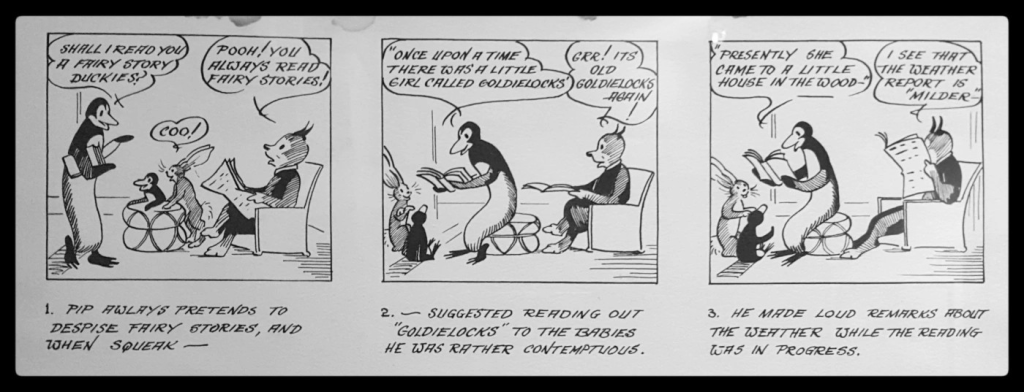
Along with the Victory and British Service Medals, Arnold was awarded the 1914-15 Star for his service with the Mediterranean Expeditionary Force . This was awarded to those who served between August 5 1914 and December 31 1915. This trio was known as Pip, Squeak & Wilfred after a comic strip in the childrens’ section of the Daily Mirror.
Gallipoli & Arnold Booth
On September 10 1914 the 1st/8th Bn., Manchester Regiment sailed from Southampton for Egypt arriving in Alexandria on September 25. On May 6 1915 they landed at Gallipoli. The diary of Private Joseph McLean gives us an insight into some of their service. His personal diary and the War Diaries for the battalion are published on the Manchesters website here.
Arnold Booth was 24 years old when he was declared missing in Gallipoli on August 7 1915. He is commemorated on Panel 161A at the Cape Helles Memorial, Gallipoli, Çanakkale, Turkey. His final resting place is still unknown.
The eight month campaign in Gallipoli was fought by Commonwealth and French forces in an attempt to force Turkey out of the war, to relieve the deadlock of the Western Front in France and Belgium, and to open a supply route to Russia through the Dardanelles and the Black Sea.
The Allies landed on the peninsula on 25-26 April 1915; the 29th Division at Cape Helles in the south and the Australian and New Zealand Corps north of Gaba Tepe on the west coast, an area soon known as Anzac. On 6 August, further landings were made at Suvla, just north of Anzac, and the climax of the campaign came in early August when simultaneous assaults were launched on all three fronts. However, the difficult terrain and stiff Turkish resistance soon led to the stalemate of trench warfare. From the end of August, no further serious action was fought and the lines remained unchanged. The peninsula was successfully evacuated in December and early January 1916.
The Helles Memorial serves the dual function of Commonwealth battle memorial for the whole Gallipoli campaign and place of commemoration for many of those Commonwealth servicemen who died there and have no known grave.
Source & more information
War Gratuity
The war gratuity was introduced in December 1918 as a payment to be made to those men who had served in WW1 for a period of 6 months or more home service or for any length of service if a man had served overseas. The rules governing the gratuity were implemented under Army Order 17 of 1919. Details of gratuities paid to deceased soldiers are shown in the soldiers effects registers. These registers are held by the National Army Museum but have recently been digitised. In most cases the war gratuity was paid to men in lieu of service gratuity due under the Royal Pay Warrant however, as the war gratuity was not introduced until 1918, many men had already been paid the service gratuity and therefore, when it was calculated, the war gratuity had to be adjusted so a man did not receive the full value of both. The monies due were generally paid in to a Post Office Savings Account for each man who had to apply for a savings book. If the man had already died or had been discharged insane an alternative payment method could be used.
Source & more information
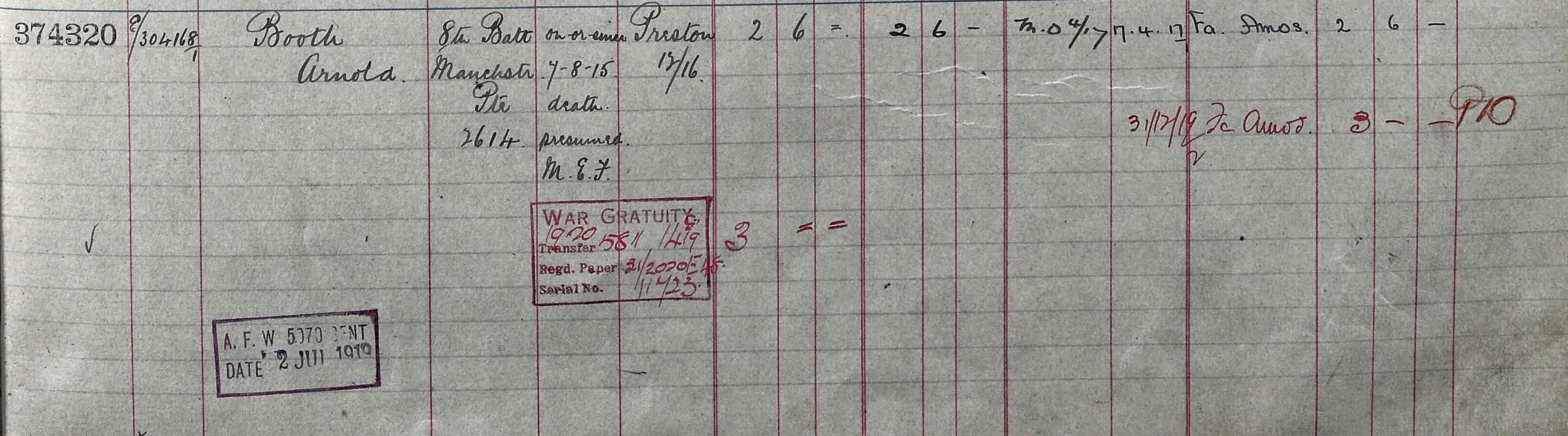
The receipt of Arnold’s War Gratuity by his father, Amos Booth, strengthens the evidence I have gathered, supporting the connection between them.
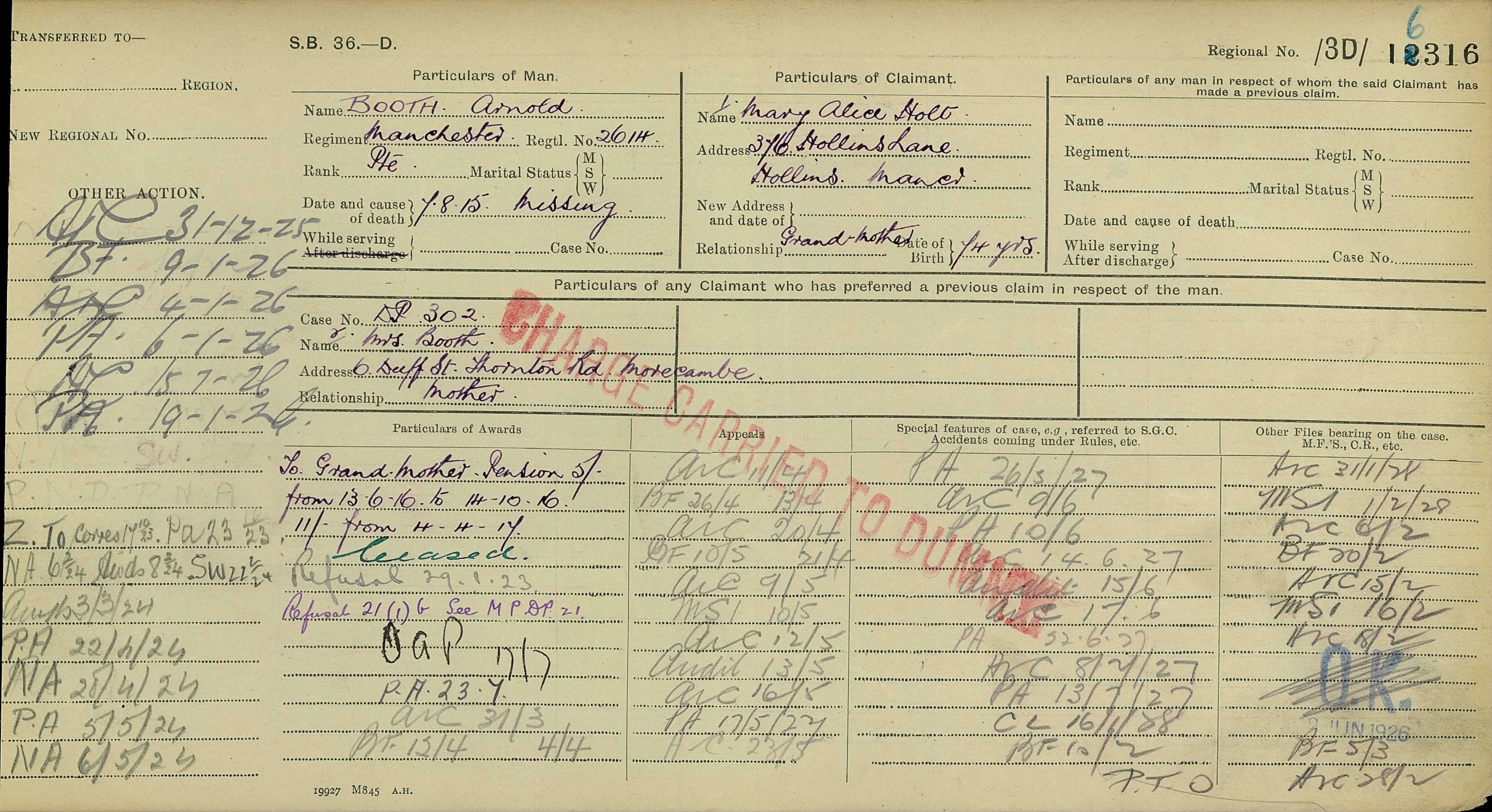
The proximity of Mary Alice Holt’s address to the address on the Baptism Record for Arnold Booth and the address on the 1891 census is striking! It’s highly unlikely that this is just a coincidence.
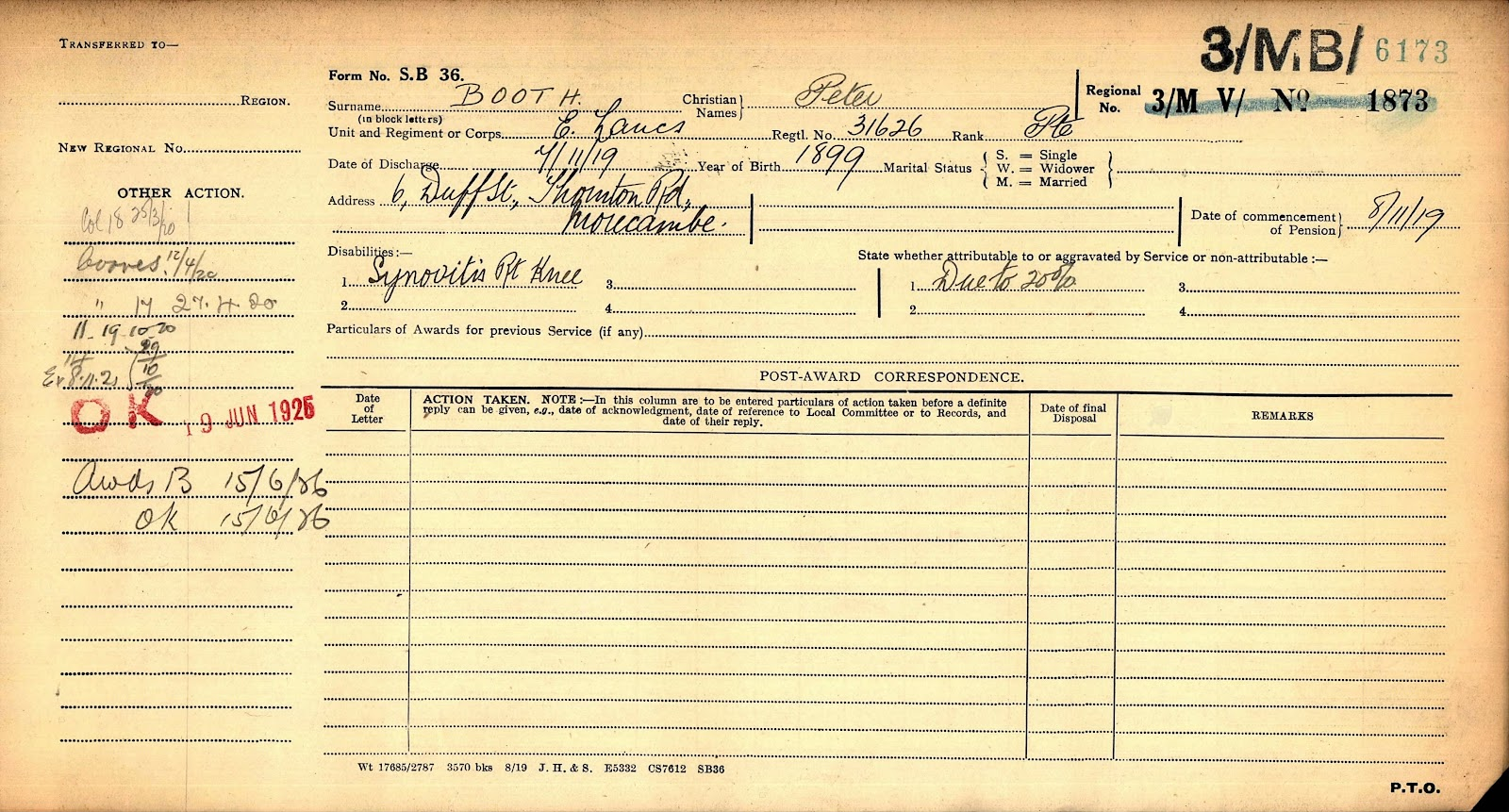
It was fantastic to discover that the address of 6 Duff Street, Thornton Road, Morecambe is absolutely identical in both instances! This confirms that I was certainly on the right track!
Ireland & Peter Booth
Peter Booth survived the war. He was awarded the Silver War Badge after being diagnosed with ‘synovitis of the knee’. 191 cases of synovitis were noted amongst pension claimants, 84% being deemed ‘attributable’ to service. A study published by The Western Front Organisation explains more about this condition.
I understand how important it is to have accurate information about our ancestors’ experiences during significant events like World War I. Unfortunately, in the case of Peter Booth, there are some gaps in the available records. I have gathered information passed down through generations of the Booth family, which recounts how Peter joined the war in 1915, motivated by the loss of his older brother Arnold. Peter would have had to lie about his age, as he would have been around 15 or 16 years old at the time.
Due to the destruction of around 60% of World War I service records during World War II, it has been challenging to find specific details about Peter’s military service. Nevertheless, I did manage to locate his Medal Index Card (MIC) , revealing that he was awarded the Victory and British Service Medals as well as the Silver War Badge. Unfortunately, the record does not provide information about the theatre of war in which he served or the exact timeframe of his involvement.
These small glimpses into Peter Booth’s experience serve as reminders of his courage and dedication during the war.
The Silver War Badge is a pin designed to be worn on civilian clothes after early discharge from the army. It was first issued in 1916, when it was also retrospectively awarded to those already discharged since August 1914. The Silver War Badge was initially called simply the ‘War Badge’; it has also been popularly known as the ’Silver Wound Badge’, ‘Services Rendered Badge’, ‘Discharged Soldiers Badge’, or ‘King’s Silver Badge’.
Imperial War Museum

The Victory Medal was awarded to military personnel for service between April 6 1917 and November 11 1918. The British War Medal was awarded to officers and men of the British and Imperial Forces who either entered a theatre of war (an area of active fighting) or served overseas (perhaps as a garrison soldier) between August 5 1914 and November 11 1918 inclusive.
Source & more information
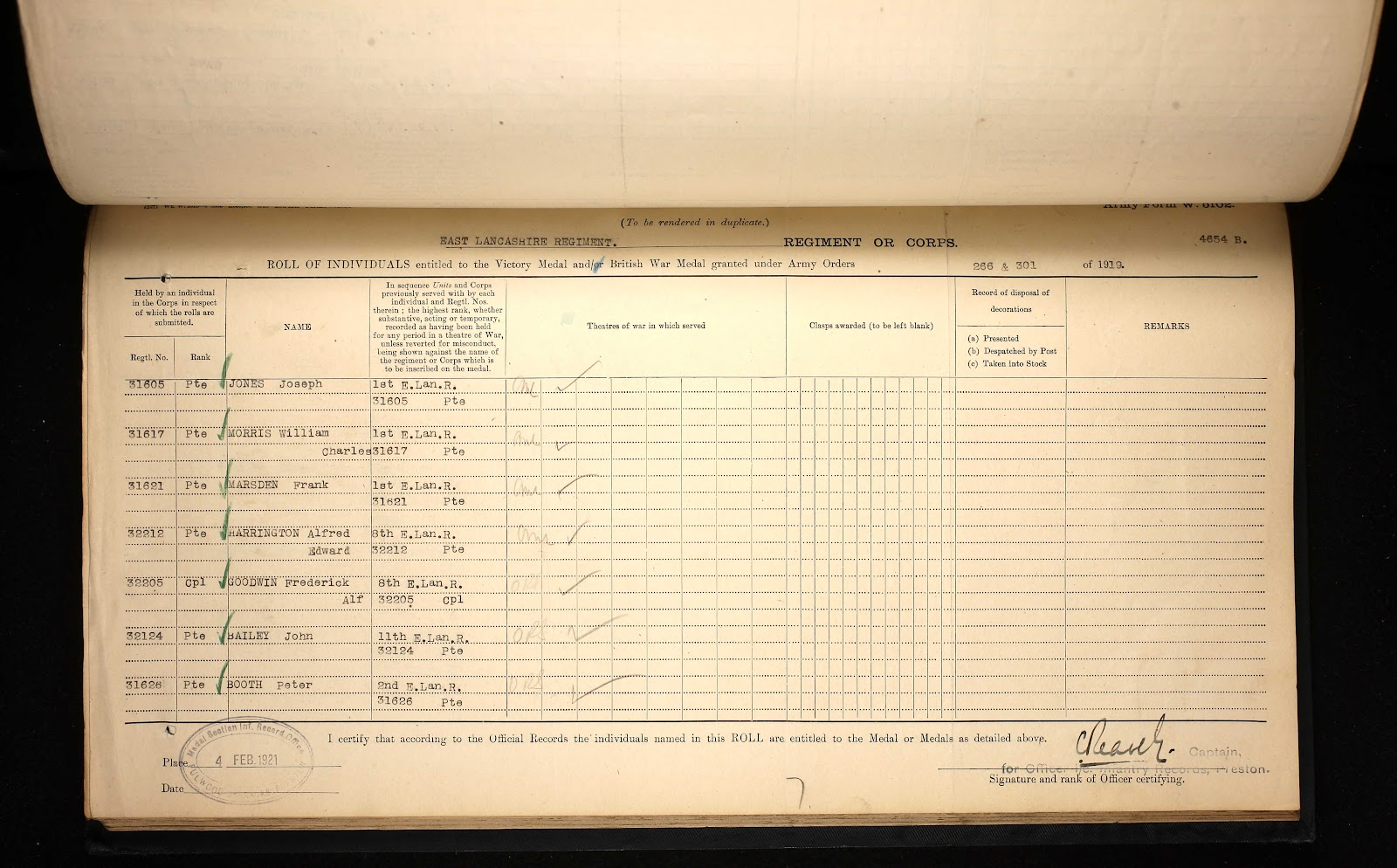
2nd Battalion East Lancashire Regiment
August 1914 : in Wijnberg, South Africa. Returned to England, landing at Southampton October 30 1914. October 30 1914 : came under command of 24th Brigade in 8th Division at Hursley Park. Landed at Le Havre November 6 1914. October 18 1915 : moved with the Brigade to 23rd Division. June 15 1916 : returned with the Brigade to 8th Division. February 3 1918 : transferred to 25th Brigade in the same Division.
Source & more information
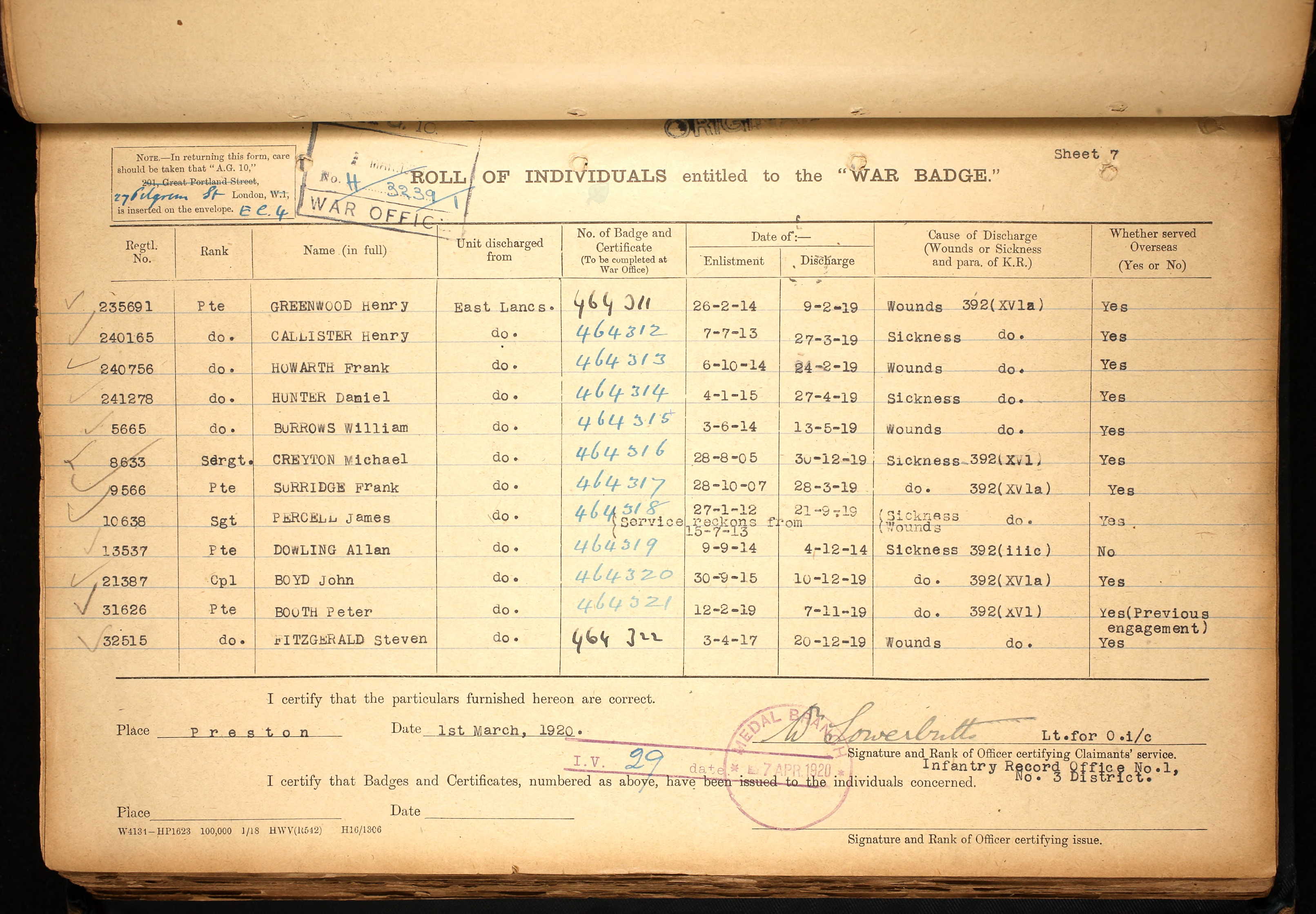
The 2nd Battalion East Lancashire Regiment moved to Ireland for four years in 1919 during the Irish War of Independence. The Silver War Badge Index Record records Peter’s service as February 12 1919 – November 7 1919 and also records that he had served overseas in a previous engagement.
Morecambe & Leeds
After his honourable discharge from the East Lancashire Regiment, Peter returned home to his family and soon found a job as a dock labourer at Heysham Harbour in Morecambe. The war had obviously taken its toll on him, both physically and emotionally, but he was determined to rebuild his life.
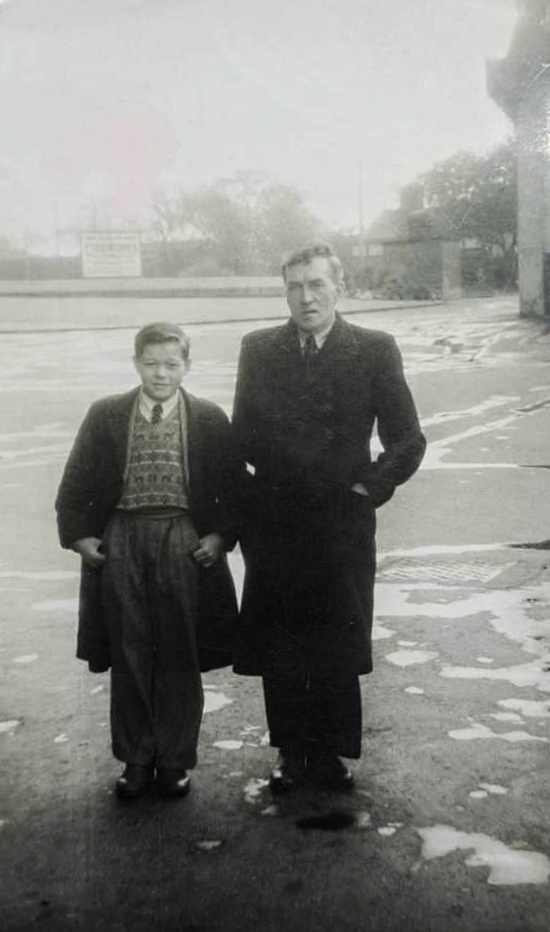
c1950
Peter Booth and Florence May Muir tied the knot in the early months of 1923. Florence, born on March 23 1899, in Morecambe, was the daughter of a grocer.
The couple welcomed their first child, Marjorie, on August 13 1923. Subsequently, they were blessed with three more children: Leslie (born on November 2, 1926), Audrey (born in 1928), and Renee (born on November 4, 1929). All these births took place in the Greater Manchester district.
By the time their son Barrie was born in 1936 the family had made their way to Leeds. Peter Jr., born on Valentine’s Day in 1940, also entered the world in Leeds. Their address, Seaforth Avenue in Harehills, Leeds, happened to be just a street away from where I would later live. Connections like these are always fascinating to me!
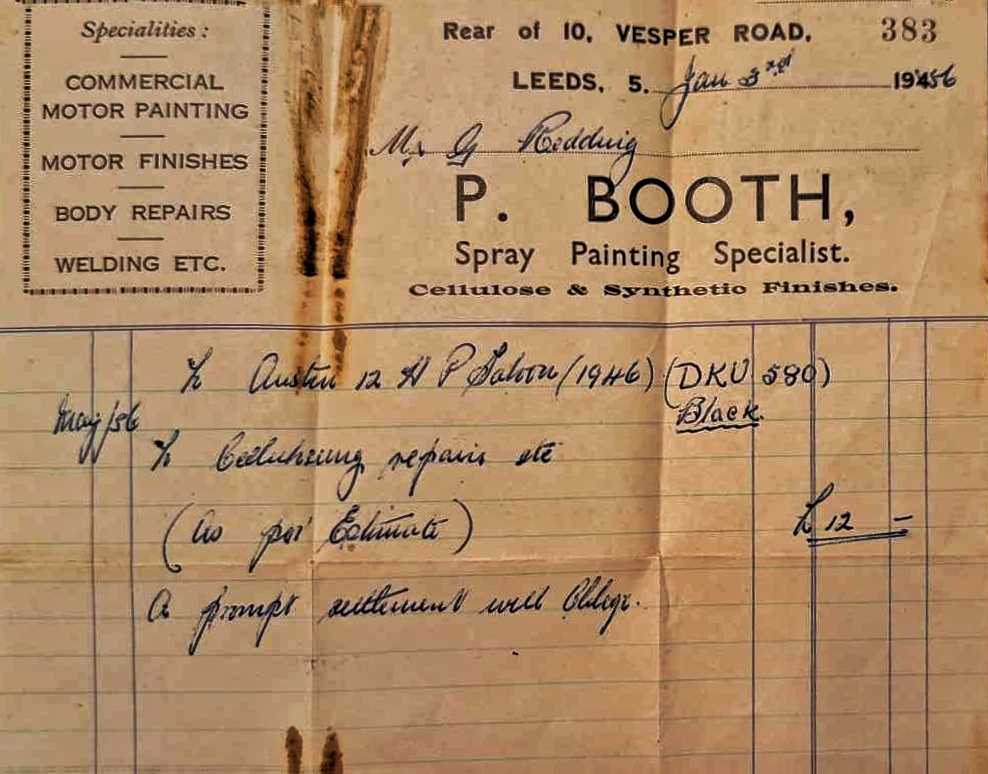
Peter Booth built a thriving business specialising in professional vehicle spray painting.
His exceptional craftsmanship and impeccable reputation attracted clients from across the United Kingdom, willing to travel great distances to benefit from his services.
Jean Booth (who was married to Peter Booth jnr.) told me that due to the devastating effects of being gassed during the war, her father in law would face struggles every winter. In the face of severe weather conditions or frigid temperatures, he would find himself unable to engage in his work.
Peter Booth died in Leeds on January 13 1959.
World War ll
F/Lt Arnold Booth DFC
Arnold, the son of Arthur Booth, carried a name of profound significance. It was a name chosen to pay homage to his late uncle, who lost his life during the First World War. Despite never having the chance to personally know his heroic relative, Arnold’s name stands as a solemn testament to a cherished family member. Poignantly, Arnold Booth met a tragic end during World War II.
Flight Lieutenant Arnold Booth was a member of the Royal Air Force Volunteer Reserve. Tragically, he lost his life on August 31 1943 while serving with 12 Squadron. In recognition of his exceptional bravery, he was posthumously awarded the esteemed Distinguished Flying Cross (DFC) on April 3 1945, with effect from August 30 1943.
Distinguished Flying Cross (DFC)
Established on June 3 1918, the birthday of King George V, the Distinguished Flying Cross (DFC) is awarded to personnel of the United Kingdom’s Royal Air Force (RAF) and other services, and formerly to officers and Warrant officers of other Commonwealth countries, instituted for “an act or acts of valour, courage or devotion to duty whilst flying in active operations against the enemy”. The award was established shortly after the formation of the RAF. It was originally awarded to air force commissioned officers and to Warrant Officers. During World War Two it was also awarded to Royal Artillery officers from the British Army serving on attachment to the RAF as pilots-cum-artillery directors. During the Great War, approximately 1,100 DFCs were awarded, with 70 first bars and 3 second bars. During the Second World War, 20,354 DFCs were awarded (the most of any award), with approximately 1,550 first bars and 45 second bars. Honorary awards were made on 964 occasions to aircrew from other non-commonwealth countries.
Source & more information
The London Gazette is one of the official journals of record of the British government, and the most important among such official journals in the United Kingdom, in which certain statutory notices are required to be published.
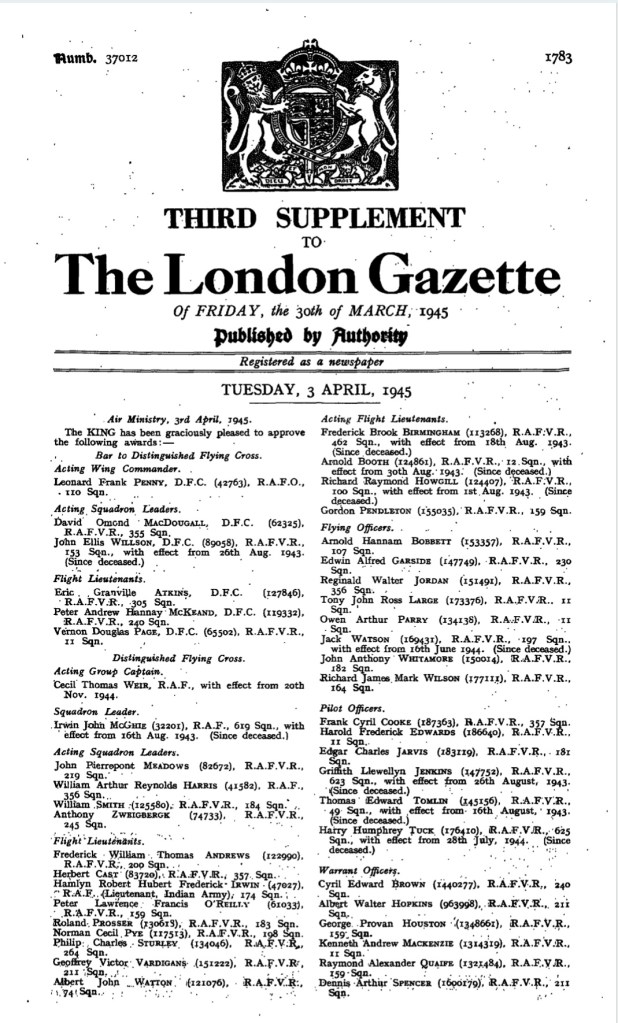
Arnold Booth was Mentioned in Dispatches three times during WW2. Take a look:
London Gazette supplement: 35704.Dated 11-09-1942
London Gazette supplement: 35919.Dated 23-02-1943
London Gazette supplement: 37012. Dated 03-04-1945

Lancaster ED972 took off from RAF Wickenby at 23:50 hours on the night of 30/31st August 1943 on a bombing raid over Monchengladbach, Germany. Nothing was heard from the aircraft after take off and it did not return to base.
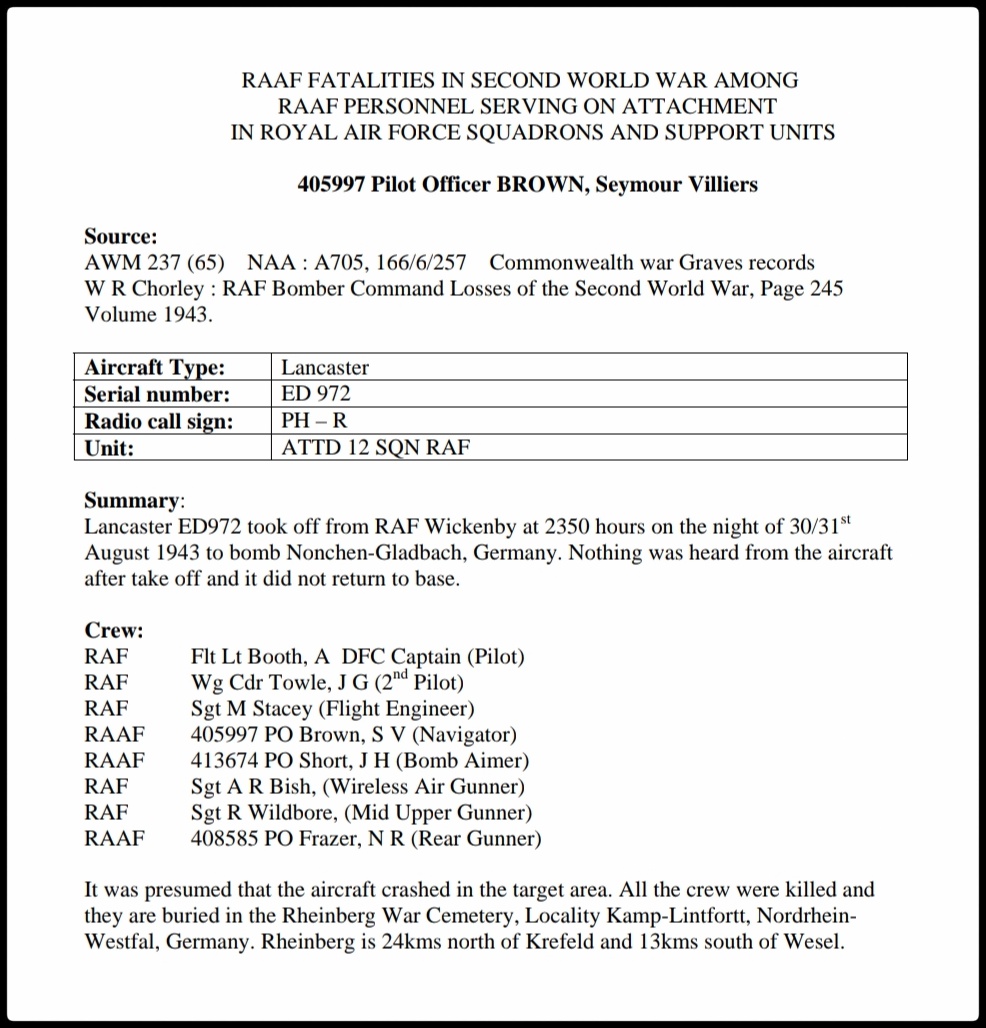
Crew: RAF Flt Lt Booth, A DFC Captain (Pilot), RAF Wg Cdr Towle, J G (2nd Pilot), RAF Sgt M Stacey (Flight Engineer), RAAF 405997 PO Brown, S V (Navigator), RAAF 413674 PO Short, J H (Bomb Aimer), RAF Sgt A R Bish, (Wireless Air Gunner), RAF Sgt R Wildbore, (Mid Upper Gunner), RAAF 408585 PO Frazer, N R (Rear Gunner).
It was presumed that the aircraft crashed in the target area. All the crew were killed and they are buried in the Rheinberg War Cemetery, Locality Kamp-Lintfortt, Nordrhein-Westfal, Germany. Rheinberg is 24kms north of Krefeld and 13kms south of Wesel.
Why Ossett?
Throughout the years, I have come across and extensively researched the stories of many of the Ossett Fallen. I am often asked how I discover these individuals. I’m not sure that I do – it feels as if they find me instead. For some reason, the medals belonging to Arnold and Peter Booth emerged in Ossett. Lost over time, it becomes increasingly vital to ensure that these stories reach a wider audience whenever they are uncovered. I’m honoured to have been able to play a part in that and I’m delighted to have been able to unite the Booth family with these medals.
We Will Remember Them
My partner, Simon Rogers, and I are volunteers for the Commonwealth War Graves Commission (CWGC) Eyes On Hands On Project.
The project enables those with an interest in the work of the CWGC to act as their eyes in their local area. Volunteers feedback information about the condition of war graves so that resources are best directed to headstones that need attention. We have been trained by the CWGC to clean and maintain our local CWGC war graves and for several years Simon has done just that.
On the day Simon crossed paths with the Booth family and the seller, James Brocklehurst, he happened to be wearing his CWGC volunteer shirt, which sparked James’ curiosity about the project. Motivated by Simon’s devotion, James graciously pledged to donate the cost of the medals to the CWGC.
Such acts of generosity truly make a difference in preserving the memory of those who served in the two world wars.
©️ ANNE-MARIE FAWCETT JULY 2023
📧 horburyandossettfamilyhistory@gmail.com
 HORBURY & OSSETT FAMILY & LOCAL HISTORY