Educator and Philanthropist from Ossett

Jane Elizabeth Tolson was just over a year old when she was baptised at All Saints Church, Dewsbury on March 2 1881, by which time the Tolsons were living at Webster Hill, Dewsbury.
However, Jane was born in Ossett on December 23 1879. Her older siblings: Henry, John Edwin and Mary Ann, were all born in Ossett and baptised at Holy Trinity Church by Rev Thomas Lee.
Jane’s parents, Martha and Robert, had deep roots in the Yorkshire area. Martha, whose maiden name was Dews, hailed from Flushdyke, with a family history in Ossett that spanned several generations. On the other hand, Robert, a carpet weaver by trade, was born in Dewsbury, where his ancestors had also lived for many years. The couple tied the knot in 1870 at All Saints Church in Dewsbury and settled near the Vicarage on Dale Street in Ossett.
Jane, with her mother Martha and four of her five siblings, were still living at Webster Hill when the census was taken in 1891. At this time Jane’s father, Robert Tolson, was a patient at Ida Hospital in Cookridge. He died in 1894 when Jane was 14. Jane’s family faced significant challenges during this period, with her father’s illness and eventual passing. The loss of her father at such a formative age would undoubtedly have a lasting impact on Jane and her siblings.
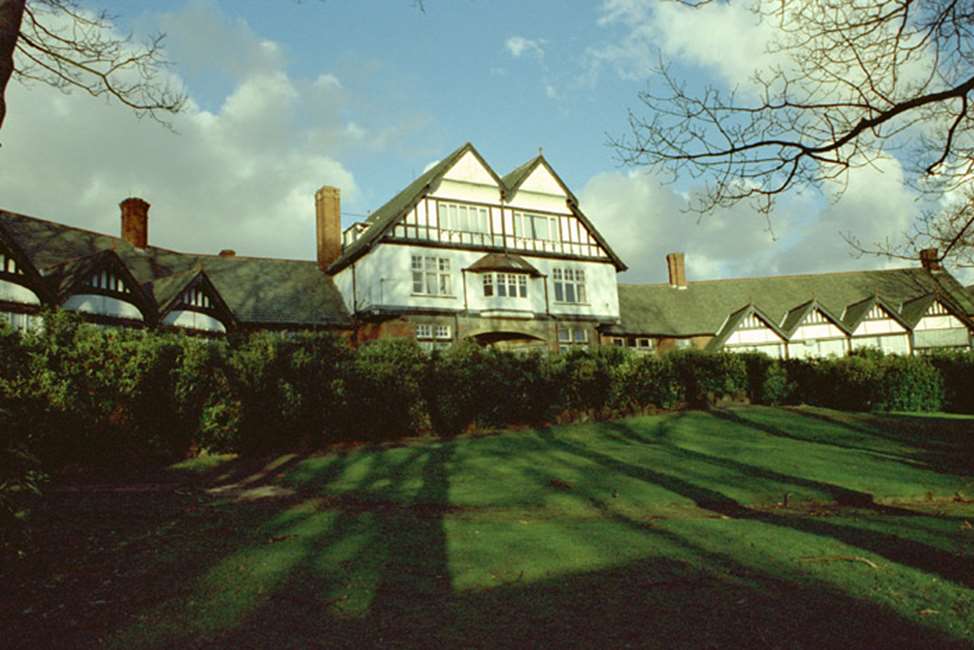
The convalescence hospital was built in c1890. A plaque in the rear entrance hall states that the building was given by Mr and Mrs North for the use of patients of Leeds General Infirmary in memory of their daughter, Ida.
Photo: 01 March 2002 © Mrs Pennie Keech. Source Historic England Archive ref: 465862. Image opens in a new window.
BROTHER BECOMES THE MAYOR OF DEWSBURY
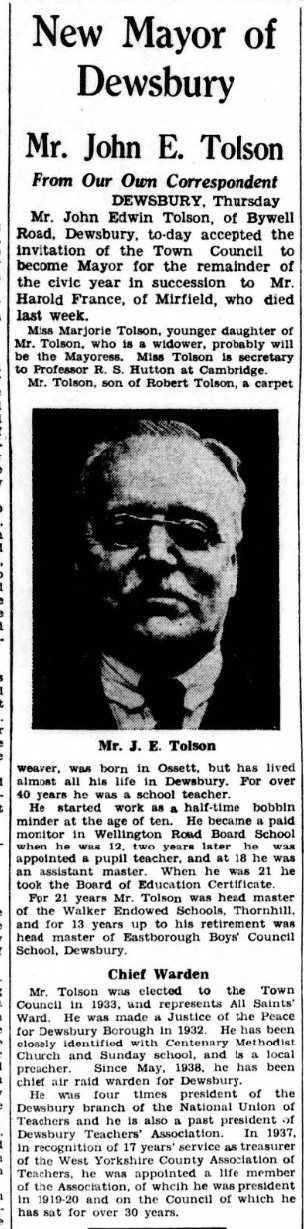
After the death of their father, Jane’s brother, John Edwin, provided a home for his widowed mother and younger siblings.. A little about his life was reported in The Yorkshire Post in 1940 when he was invited to take over as the Mayor of Dewsbury. He began his working life in a mill at the age of ten. When he was 12, he became a paid monitor at Wellington Road School, and two years later he was a pupil teacher. At 18, he was an assistant master, and at 21, he took the Board of Education Certificate. For 21 years, he was the Headmaster of the Walker Endowed Schools at Thornhill, and for 13 years, he was Headmaster of Eastborough Boys Grammar School, Dewsbury.
JANE JOINS THE TEACHING PROFESSION
Jane, who was educated at Southland College in Wimbledon, followed her older brother into the teaching profession. A qualified teacher, geography specialist, member of the Royal Geographical Society and linguist, Jane held a series of teaching posts in Yorkshire; by 1911 she had become a headteacher for Staffordshire County Council. It was whilst teaching at Quarry Bank Board School in Worcestershire that she met her future husband Albert Shaw and in the spring of 1924 they were married.

At the age of 23 Albert had established himself in business as a mineral water manufacturer. In 1907, Cllr Albert Shaw of Quarry Bank and owner of Shaw’s Mineral Waters of Quarry Bank and Cradley Heath invented a modification to the Codd bottle, with addition of glass bars to reduce weakness and glass breakages when cleaning the glass bottles after use.
Read more about Albert Shaw here
LEAMINGTON & SOUTHLANDS
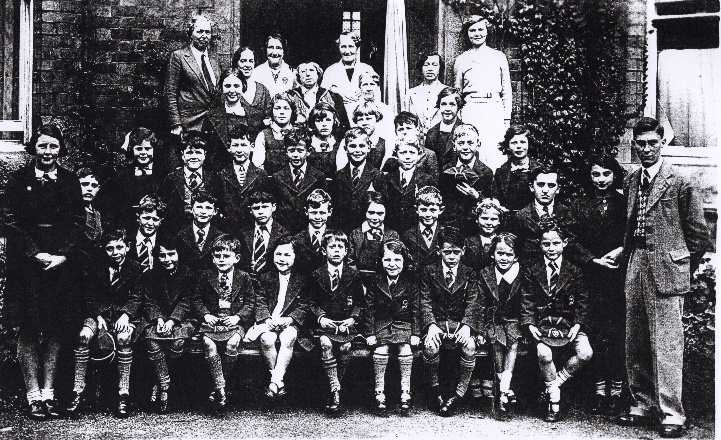
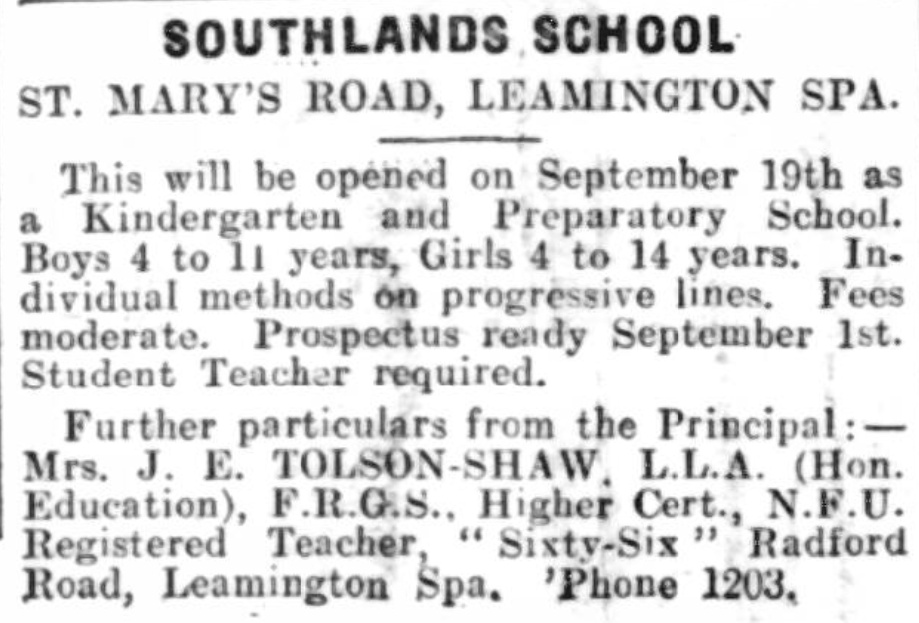
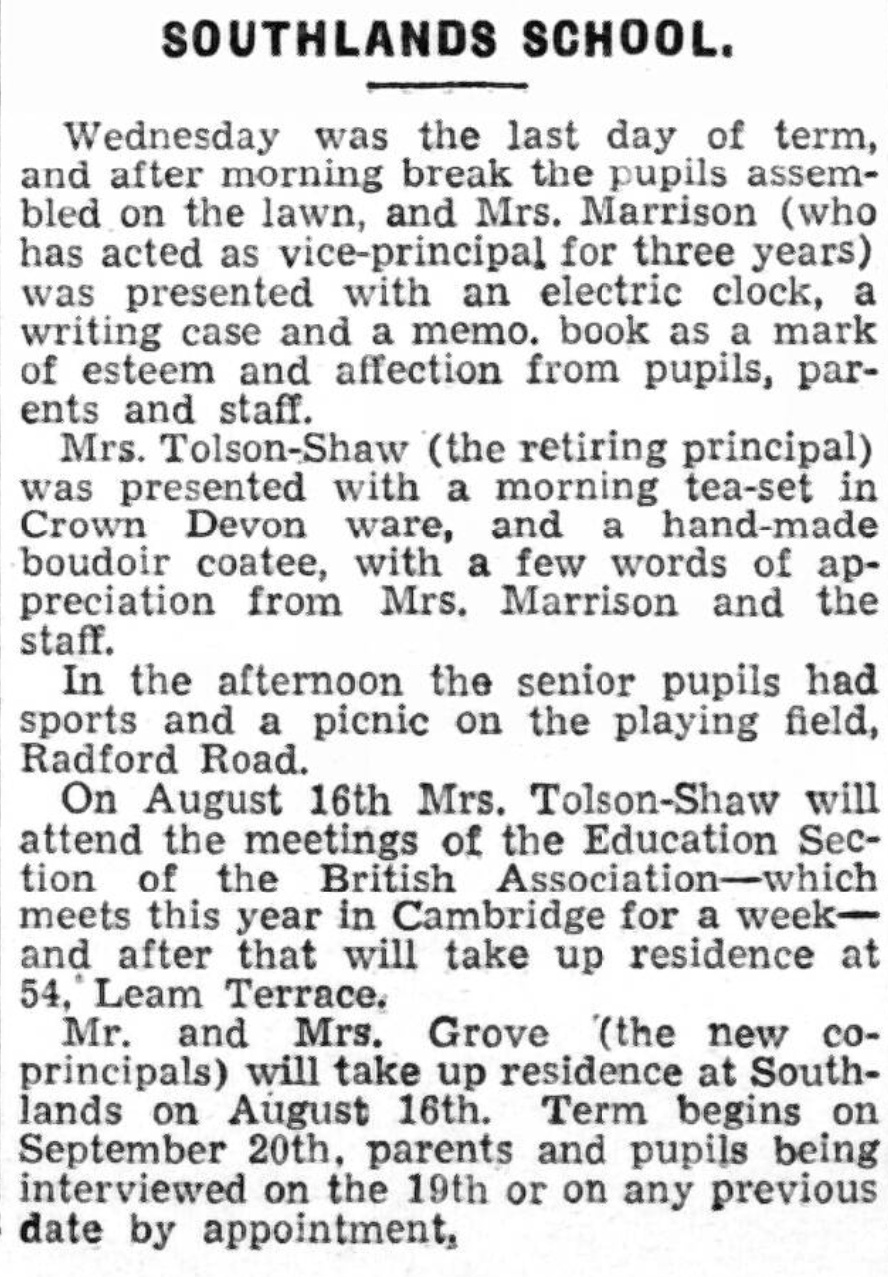
Jane Elizabeth Tolson-Shaw subsequently moved to Leamington where, in 1933 with only five pupils registered, she founded Southlands School, named after her old college. The school was known as ‘The Garden School of Happy Childhood’.

Leamington Spa Courier
Opens in a new window
Leamington Spa Courier
Opens in a new window
According to contemporary Nickie Hall in a memoir, as she loved royal purple (and often wore it), Jane chose the colour for her pupils’ uniform.
The school soon grew and began to take boarders whose parents were often serving overseas in the diplomatic services.
During school holidays when many of the boarders had nowhere else to go Jane simply took them home with her. The school motto, incorporated into the gothic silver ‘S’ embroidered on the uniform was ‘Service’.
Jane was the author of a book on paper-making, an examiner for the Associated Board, a gifted pianist and composer who could be relied on to produce appropriate pieces for any school production.

Leamington Spa Courier
Opens in a new window
She was ahead of her time in moving away from the strict school prescription of the three Rs, believing strongly in nourishing intellect by enthusiastic support of the individual with access to a wide curriculum. Maps were a prominent feature throughout the school, as part of that curriculum.
Citizenship, a significant feature in 21st century schools, always featured largely at Southlands, with emphasis on the work of the police, mayor-making and other civic functions and responsibilities.
Leamington Spa Courier
Opens in a new window
In addition to running Southlands, Jane played a significant role locally in youth work at St Mary’s Church, a short distance away from her school.
She founded St Mary’s Junior Church, contributing generously towards the conversion of the south aisle into a chapel for young people, with stained glass windows showing St Francis of Assisi, and Saint Cecilia, the patron saint of music.
With her backing, St Mary’s Guild of Youth put on musical events and plays, had talks from guest speakers, and held ‘at home’ events at the Pump Rooms.

In 1945, Jane donated a painting, ‘The Young Reader’, by Miguel Mackinlay (1893–1959), to the Junior Library at Avenue Road. It is now in the collection of the Leamington Spa Art Gallery and Museum.
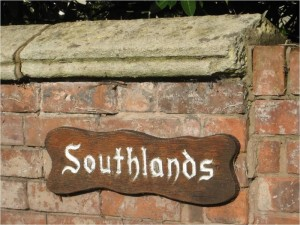
When she left Leamington, Jane made a gift of Southlands to St Mary’s Church, to be used primarily as a youth centre, but she also hoped that (with a resident warden) the bedrooms might be used for older parishioners. The house was sold in the 1970s and subsequently demolished. The name is preserved at the entrance to the housing development that took its place.
In 1975, funds from the sale of Southlands was used to purchase a former brewery warehouse called The Maltings and it was used as a church youth centre called The Landing Stage. In 1985 a plaque was unveiled at the centre to commemorate Jane Elizabeth Tolson-Shaw. The Maltings were later sold and converted to housing.
AN AVID TRAVELLER
Jane was an avid traveller and in 1950 she toured America. Whilst there she attended the Soroptimists Convention and she lectured on the subject of British Women.

Birmingham Daily Gazette
Opens in a new window
From 1951 Jane began to live part of the year in Cyprus. She continued to spend six months of the year in Cyprus even through the Cyprus Emergency 1955-1959 and was said to have done much for British/Cypriot public relations. The children there knew her as ‘Auntie Jane’ and to their parents she was ‘Madame Shaw’. she was often top of the guest list at their birthday parties. It’s obvious that Jane loved children; and they loved her.
In her 80s, Jane was still travelling, spending her winters first in Cyprus and later in Bermuda. She died aged 93 on October 30 1972, and is still fondly remembered by a handful of old pupils.
Jane Elizabeth Tolson-Shaw (1879-1972)
Born in Ossett.
 HORBURY & OSSETT FAMILY & LOCAL HISTORY