OSSETT HOLY TRINITY CHURCH
©️ Anne-Marie Fawcett
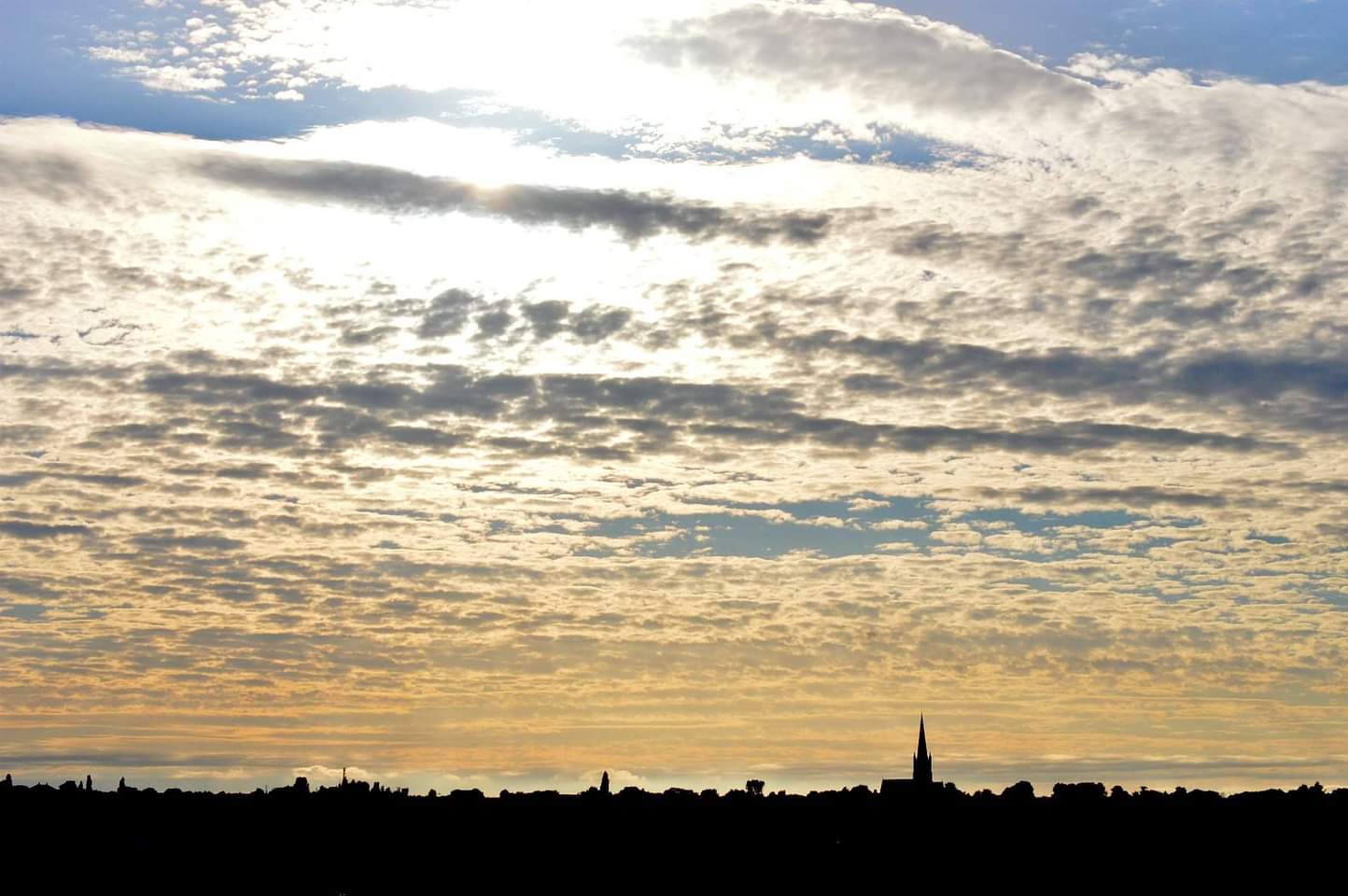
Photos: Nev Ashby ©️
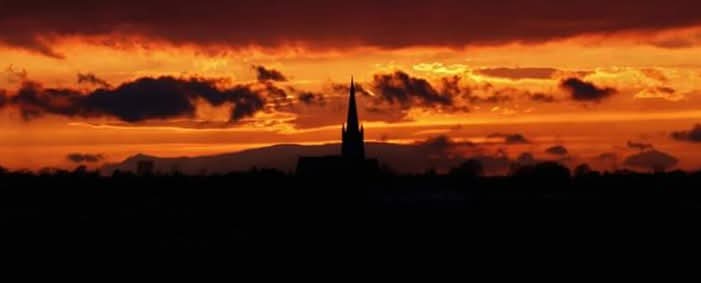
Standing 226 feet tall and situated on a plateau some 300ft above sea level, the Church of the Holy and Undivided Trinity dramatically dominates the skyline for miles around. At its consecration on Friday July 14 1865 it was referred to by the Bishop of Ripon as a ‘miniature cathedral’. A large, impressive church, it is an important and instantly recognised landmark in the area and was afforded Grade ll* listing in May 1988.
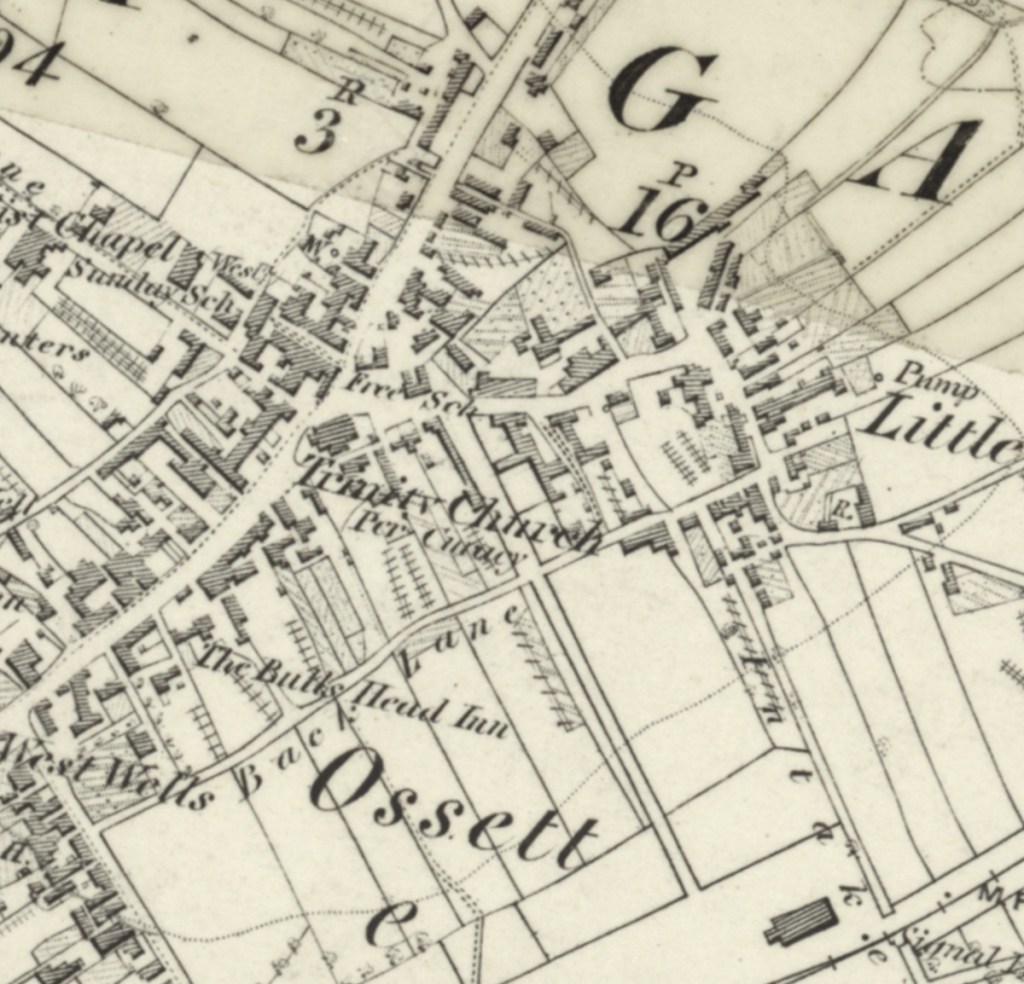
Ossett has been served by chapels and churches since around 1409 and this magnificent edifice replaced the original Trinity Church which had been erected in the Market Place in 1806 – which itself replaced an even earlier place of worship.
The old church was largely financed by Reverend Edward Kilvington who ultimately became so big and heavy that he couldn’t get up the stairs of the pulpit. This led to the installation of a three-decked pulpit, which in reality was a primitive lift. Before the Sunday service, he got into his chair at the bottom of the pulpit steps and then the church sexton, by hauling a rope, slowly wound him up to the top level! The old church, which was said by some to have looked more like a courthouse and was described as ‘small, inconvenient and an obstruction to traffic’, was inadequate for the needs of the township; yet it was almost 60 years before a new church was provided.
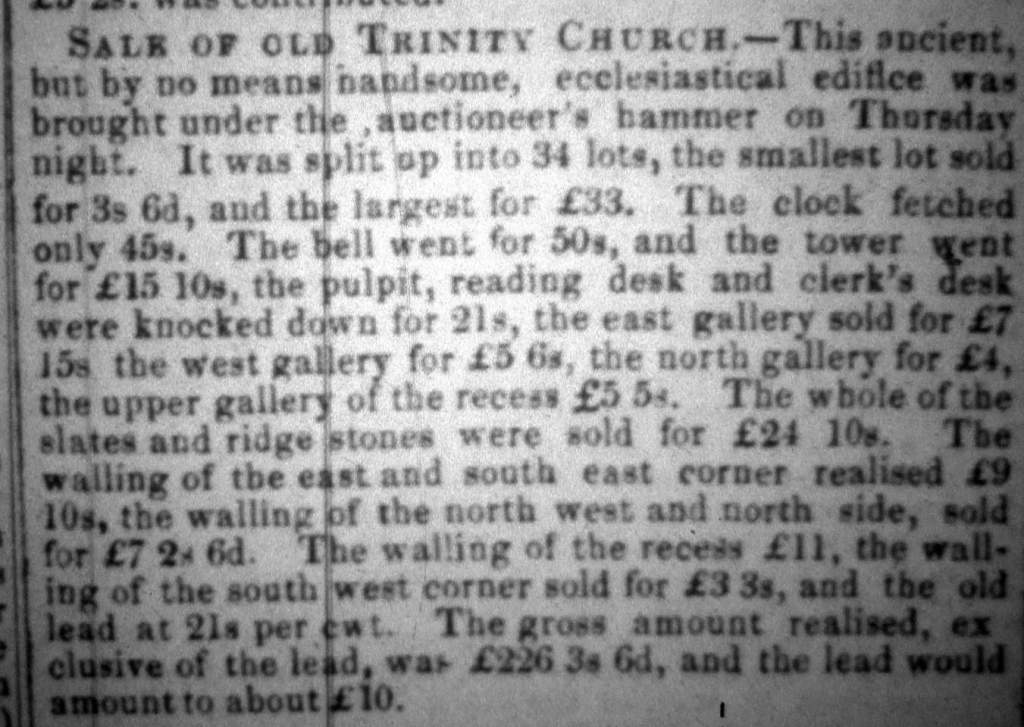
The old church in the market place was closed after Holy Trinity opened in 1865, and the following year the materials of the building were sold by auction for £226-3-6, with demolition and removal of these materials starting the same day as the sale.

To give us an idea of where the old church once stood, Steve Mitchell (OTTA) has used the only photograph of it known to exist and merged it with an image from today’s Ossett.
The site of the old church continued to be used as a meeting point, years after it was demolished.
○~○~○~○~○~○
CYCLISTS’ PROCESSION: AN INTERESTING SPECTACLE
On Wednesday evening there was the most brilliant turn out of cyclists that ever was seen at Ossett (numbering over 130 machines) assembled at the the Old Church Ground, at about 7:30. The cycles were beautifully decorated and festooned and, in addition to the other decorations, a large number of them were also lighted by Chinese lanterns. The cyclists came from Batley, Dewsbury, Hanging Heaton, Wakefield, and Castleford. It was said there were more people in Ossett to watch the procession than there were on Charter day, and the crush then was tremendous. Leaving the Church Grounds the procession went by way of Town End, along Wakefield Road, down Field Lane, and the Green, in and by way of Giggal Hill to the Spa, returning by the new railway road to the point of starting. The riders, many completing the circle in two hours, were attired in fantastic and brilliant costumes. Altogether it was a grand affair, and one that will long be remembered in Ossett. After the ride the party adjourned to the Cock and Bottle, where a smoking concert was held, Mr. Wilby, of Wakefield, presiding. It was a merry affair.The photo shows the demolition of the old Holy Trinity Church c1866. It is the only photo of the church known to exist.
Batley Reporter and Guardian ~ September 12 1891
In 1915 one man’s memories of the old church were recorded in the Ossett Observer. He said the boys sat on one side and the girls on the other, behind the vicar who preached in a black gown. The parish clerk, John Nettleton, used to announce the hymns in a loud voice, saying: “Let us sing to the glory of God hymn number” such and such. (Cheers Nev!)
A manufacturing town with a great trade in rag and wool, it has an imposing town hall and a peace memorial with a soldier looking down on the marketplace. Holy Trinity Church, rebuilt last century, is a lofty pile looking its best outside, its great central tower crowned with a spire. The quaint little house of 1684, near Storrs Hill road, would be a familiar sight to Benjamin Ingham, the Ossett boy who began life in 1712, became an enthusiastic member of the Oxford group known as Methodists, and was a lifelong friend of John Wesley. He was with Wesley in Georgia, but when he came back he joined the Moravian settlement near Leeds, and afterwards formed a strange religious order of his own known as Inghamites.
English writer, journalist and educator Arthur Mee (1875-1943):
The King’s England, Yorkshire, West Riding, first published in 1941.
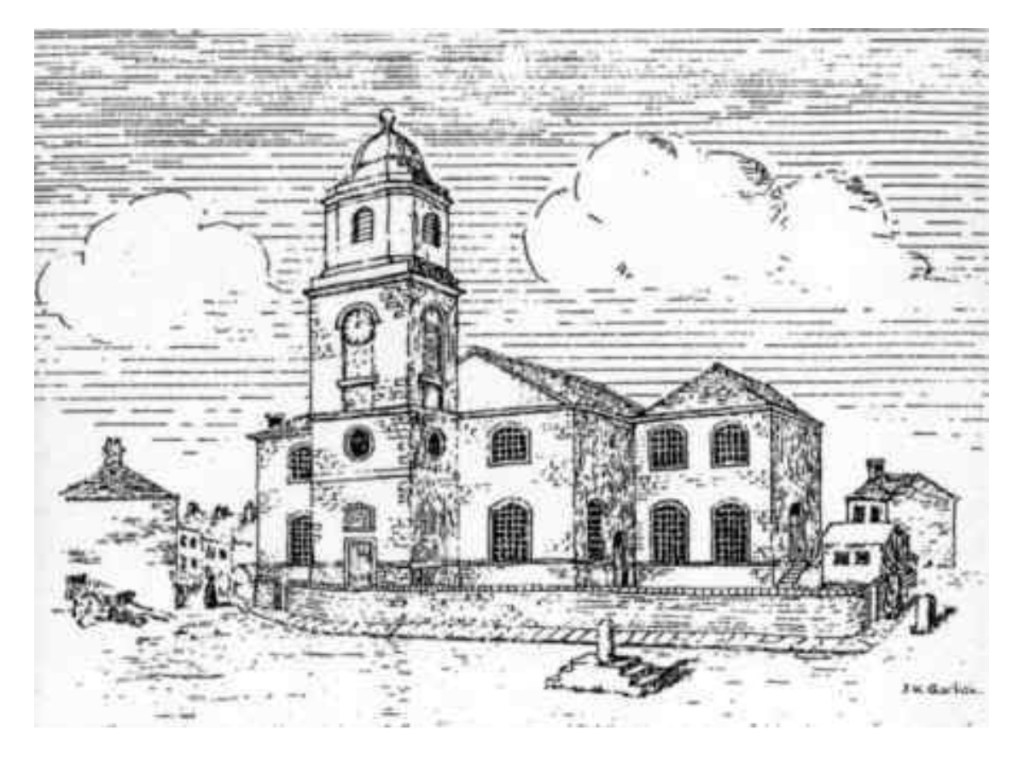
This sketch of the old Chapel of Ease by JK Garlick, Ossett’s Borough Surveyor, suggests that there may be in existence a photo, sketch or etching of this building. We’re yet to find one of it in its entirety.
Note the horse mounting block.

March 31 1974, Borough Surveyors Department. The last working day before becoming Wakefield Metropolitan District Council. Mr Garlick (Borough Surveyor) is second left, on the middle row.
○~○~○~○~○~○~○
THOMAS LEE
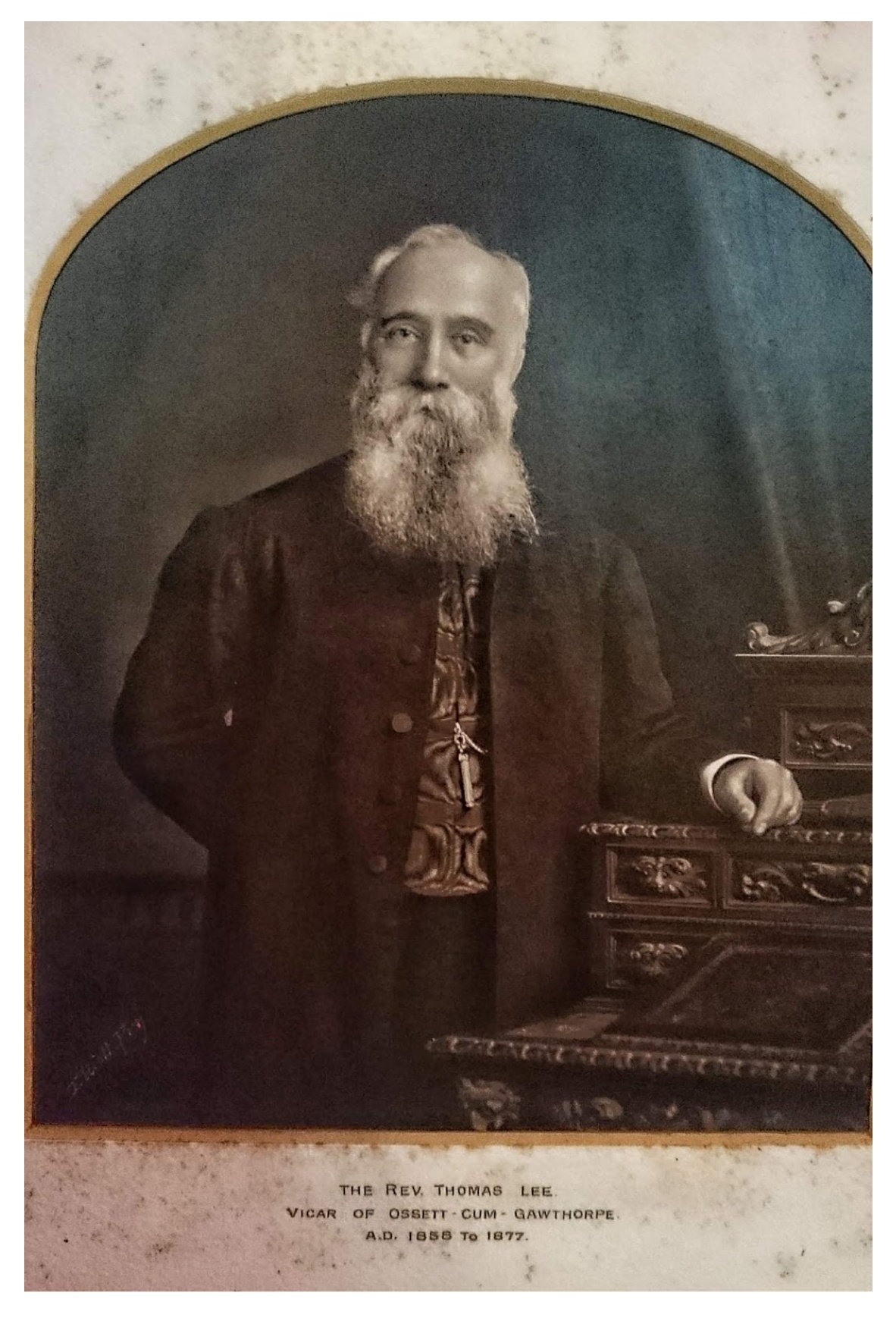
Photo: Author 2016 ©️
Born in Middlesex in 1825, Thomas Lee was the son of a gentleman and was said to be ’eminently suited to serving Ossett’.
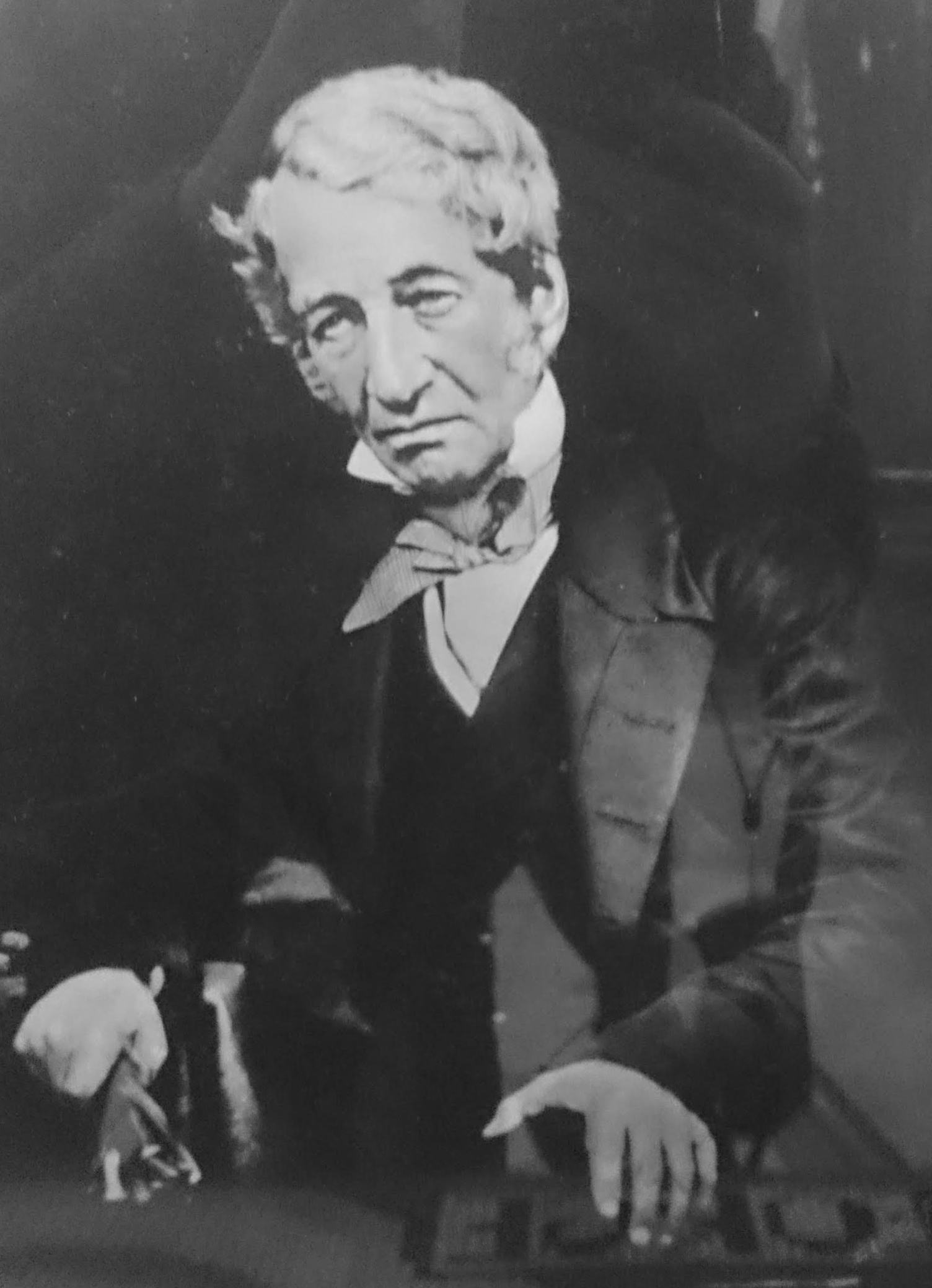
Incumbent of Ossett 1826-1858
Rev Lee was the first vicar of the new Holy Trinity Church, replacing Rev. Oliver Levy Collins from the old church.
By the age of 28 he was the curate of St Mary’s in Bilston, Staffordshire. That same year, 1853, he married Harriet Ann Norman, the daughter of a stockbroker.
In 1858 Ossett was declared a separate parochial district, having previously been in the parish of Dewsbury. In this year, Rev Thomas Lee was offered the living at Holy Trinity Church – but not the one with which we are familiar. This church was actually a chapel of ease and it was situated in the Market Place (still known then as Dale Street). The chapel was built in 1809 and replaced a much earlier place of worship but as the population of Ossett grew, the church became inadequate for the needs of the town and it was decided to build a new one.
In 1861 three acres of land on Field Lane was purchased and later that year a license was obtained to use it as a burial ground. Joseph Wilson was the first burial there in December 1861 and today almost 16,000 people are buried in this graveyard which contains many Victorian monuments and 15 Commonwealth war graves. The new church was to be built on the adjacent land and subsequently the name of the thoroughfare was changed to Church Street.
Gift of a new window, the workmanship of Heaton, Butler & Bains (sic.)of London. Heaton, Butler & Bayne

Clement Heaton (1824-82) and James Butler (1830-1913) went into partnership in London in 1855. A close relationship with the firm of Clayton & Bell led to Clayton’s outstanding pupil, Robert Turnill Bayne (1837-1915), joining the firm in 1862. Bayne, along with his younger colleague, Alfred Hassam (1843-69) drove the firm’s development, and their windows from 1862 – c.1868 placed them in the top rank for that most creative period. One of the largest and most prolific studios of the nineteenth century, the business survived until the death of RT Bayne’s grandson Basil Richard Bayne in 1953.
Rev Lee and his wife Harriet lived in the Vicarage on Dale Street with their son, Freddy. They were also to have a daughter but sadly she died in 1874 shortly after her first birthday. She was laid to rest in the churchyard of the new Holy Trinity Church, with her father leading the burial ceremony.
In 1877 Rev Lee moved his family to Islington, where he became the Vicar of St John the Baptist until 1883. Rev Lee died in October 1892 and Harriet died the following October. Their only surviving child, Frederick Bethune Norman Lee, also became a vicar. That’s a great name already but, in 1881 he changed it to ‘Frederick Bethune Norman Norman-Lee.’ He was ordained in 1883 and became Chaplain to the Forces.
Although it would seem that the service record of Chaplain/Colonel FBN Norman-Lee hasn’t survived I can tell you that, during the years 1883 – 1899 he served at Chatham, Aldershot, the Curragh in Ireland, Nova Scotia in Canada, Gosport and Portsmouth. In the South African War of 1899 – 1901 he was chaplain to the 6th Division and took part in the relief of Kimberley and the battles of Paardeberg and Bloemfontein. As if all that wasn’t enough, he also served during WW1. Rev Frederick Bethune Norman Norman-Lee died in 1921 in Hampshire. He left a widow but no children.
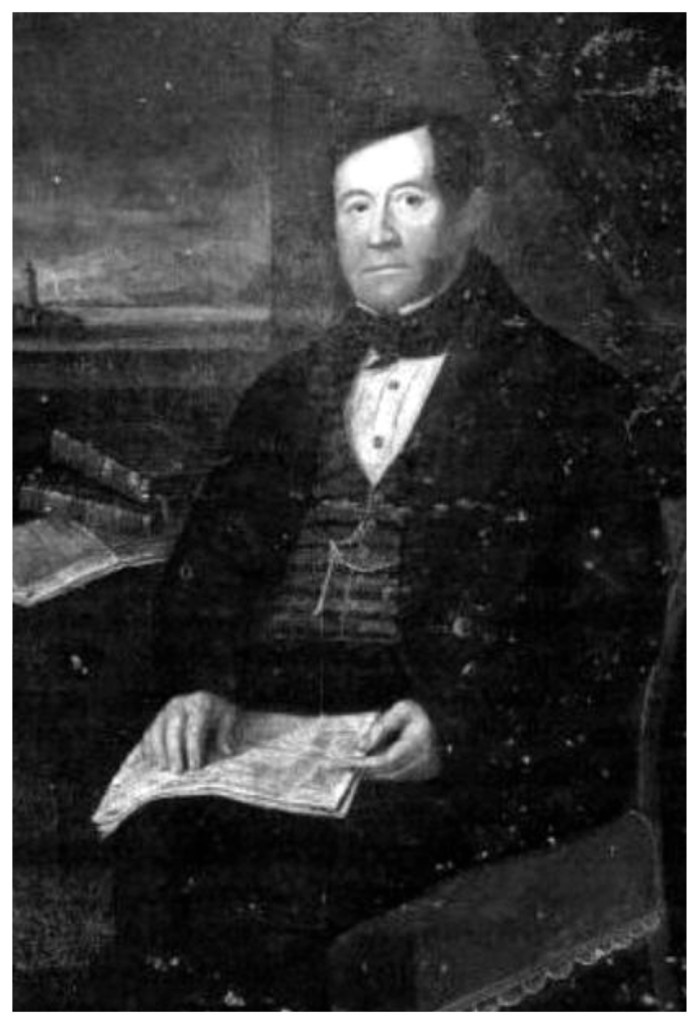
The foundation stone of the new church was laid on June 30 1862 by Benjamin Ingham who was the nephew of the Ossett born Benjamin Ingham snr*; the founder of the trading dynasty of Ingham, Whitaker & Co. in Sicily. It is claimed that Benjamin Ingham snr was possibly the greatest tycoon England has ever known and when he died in 1861 he left a fortune of £12,000,000. That would now be the equivalent of more than £1 billion. He didn’t forget his Ossett roots and bequeathed £1,000 of his fortune to the Church Building Fund:- equivalent to almost £90,000 today.
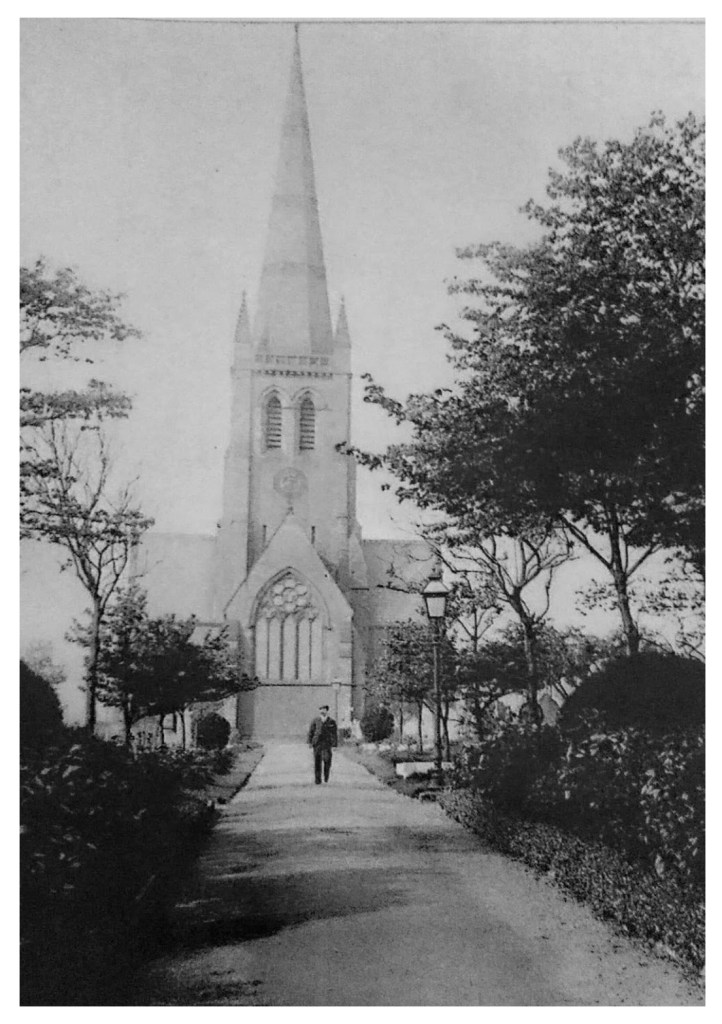
The honour of laying the first stone of the new church fell to Reverend Lee. He also had the honour of being hoisted to the top of the church to lay the last stone on the steeple. He then unfurled a Union flag as a brass band played ‘Rule Britannia’! The architect in charge, William Henry Crossland of Halifax, was a pupil of Sir George Gilbert Scott, whose Gothic Revival influence is apparent throughout.The main features include: a 226ft spire, one of the tallest in Yorkshire; a 16 bell Belfry, allowing a unique 15 bell peal; magnificent stained glass windows; an Isaac Abbott organ; an original four faced Potts turret clock; and significant Last Supper reredos, pulpit and stone carvings.
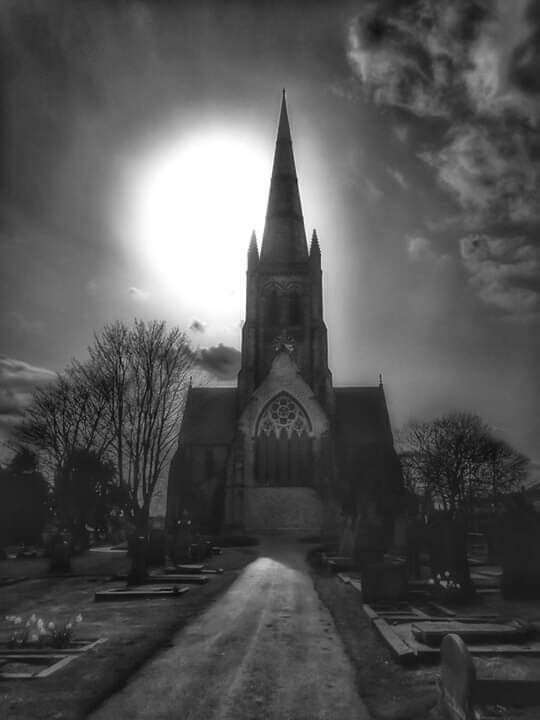
Though initially estimated at £8,000, alterations and additions to the original plans meant that the final cost of construction amounted to around £16,000 (more than £945,000 today). Such was the scale of the project that, during the consecration service of 14 July 1865, the Bishop of Ripon made reference to ‘this miniature cathedral’.
Ossett stood in the Diocese of Ripon from 1836 until the Diocese of Wakefield was created in 1888. In 2014, following the dissolution of the historic dioceses of Bradford, Ripon & Leeds and Wakefield, Ossett became a part of the Leeds Diocese.
Covering an area of around 2,425 square miles, and a population of around 2,642,400 people, this is one of the largest dioceses in the country and its creation is unprecedented in the history of the Church of England.
○~○~○~○~○~○~○
SAMUEL RUDDOCK (1827–1903)
©️ Anne-Marie Fawcett 2024
In 1864, Samuel Ruddock carved the magnificent reredos at Holy Trinity Church, Ossett. In the centre is the Last Supper, and at the sides, the annunciation, the birth, the praying in the garden, and the bearing of the cross, with the words: “With desire I have desired to eat this passover with you before I suffer.”

Photo ©️ Anne-Marie Fawcett 2016
The Last Supper panel was exhibited by Samuel Ruddock at the Royal Academy in 1864. Reference:The Royal Academy of Arts; a complete dictionary of contributors and their work from its foundation in 1769 to 1904.
Samuel Ruddock was born in Horbury and baptised on September 2 1827 at St Peter & St Leonard’s Church. He was the youngest child of Mary Armitage (1788–1862) and David Ruddock (1787–1830) who were married in Horbury on August 28 1808.

Yorkshire Parish Records
Reference Number: WDP135/1/2/1
David Ruddock was a cloth manufacturer and died in Horbury in 1830, leaving a widow and eleven children. Mary Ruddock moved away from Horbury; by the time the 1841 census was taken she was living at Coney Street, York in the home of Edward Jackson (1788–1862). Edward Jackson, who was a goldsmith and jeweller, had married Mary’s daughter Elizabeth (1809–1890) in York in 1838. Elizabeth wasn’t recorded at this address on the 1841 census, but she was recorded there on both the 1851 and the 1861 census returns.
Worth noting is Elizabeth and Edward’s son John. The youngest of their five children, born in 1851 at 15 Coney Street, York, John was a civil engineer and engineering contractor, the proprietor of the major British engineering firm of John Jackson Ltd and the shipping company Westminster Shipping Co Ltd. In 1895 he was knighted by Queen Victoria for his work on the Manchester Ship Canal. He also carried out the foundation work for the Tower Bridge, London. Sir John Jackson, C.V.0., LL.D., F.R.S.E.

Source Citation:Class: HO107; Piece: 1143; Book: 6; Civil Parish: Birmingham; County: Warwickshire;
Enumeration District: 13; Folio: 7; Page: 6; Line: 8; GSU roll: 464180
By 1841,13 years old Samuel was an apprentice in the Birmingham home of mason, James Read.
On September 18 1850, Samuel Ruddock married sculptor’s daughter, Sarah Schofield (1831-1877) at Holy Trinity Church in Lambeth. Samuel gave his occupation as that of ‘stone carver’. Their son, Oliver Schofield Ruddock, was born in 1851 and his baptism record reveals the family address as ‘Mead Place, Lambeth’.
The family lived mostly in the Lambeth area of London, except for a period when they lived at 22 Bloomfield Terrace, Pimlico; their next-door neighbour was the Belgian-born sculptor, Theodore Phyffers who specialised in altar carvings, reredos and reliefs in wood, stone and brass. His work can be found in the cathedrals of Carlisle, Limerick, Canterbury, Antwerp, and St Marie, Sheffield.
In 1862, Samuel Ruddock was awarded first prize in the carved stone panels section at the annual meeting to distribute prizes to ‘art-workmen’ at the Architectural Museum, South Kensington.
In 1864, whilst employed as the Director of Sculptors on the building of the Church of St Stephen the Martyr in Copley, near Halifax, some scaffold gave way injuring Samuel. The church was built for the industrialist Edward Akroyd, and designed by W. H. Crossland.
Architect William Henry Crossland, a pupil of Sir George Gilbert Scott (architect to Westminster Abbey etc, etc) understood how decorative stone and wood carving could bring a building alive and, depending on the funds available, used it as much possible, favouring Samuel Ruddock to work on several of his Yorkshire churches – including Holy Trinity Church, Ossett.
For the Church of England, W.H. Crossland designed at least sixteen new churches and restored ten others. For Sir John William Ramsden he designed the Kirkgate Buildings (1878–85), Byram Arcade (1878–81), and the Ramsden estate office (1868–74) in the centre of Huddersfield, and Rochdale Town Hall, built in 1866-71.
Between 1865 and 1869 the York sculptor and carver George Walker Milburn (1844-1941) was an apprentice of Samuel Ruddock. On completion of his studies, George returned to his native city of York and set up his own stone yard at 53 Gillygate. One of his first commissions was to restore the South Transept of York Minster. George and his company were responsible for much of the public sculpture in York. They also worked on commissions for the cathedrals in Durham, Chester, Lincoln, Carlisle and Rochester. In 2016 a Blue Plaque for George Walker Milburn was erected in St Leonard’s Place, York.
A reredos, made from alabaster and Caen stone, representing the Agony of our Lord in the Garden, the Scourging and the Mocking, enclosed in a rich Gothic frame work of Caen stone, each pillar exhibiting a figure carved in alabaster, bearing on shields the emblems of the Crucifixion was also created by Samuel Ruddock. He was also responsible for the carving of the crockets on the battlements of the east wall of Wakefield Cathedral.
Sir George Gilbert Scott, worked on Wakefield Cathedral between 1857 and 1874, restoring the exterior of the church to its late mediaeval appearance. His involvement included re-casing the tower and rebuilding the spire.

Newspaper: Yorkshire Post and Leeds Intelligencer

Newspaper: Yorkshire Post and Leeds Intelligencer

Newspaper: Wakefield Free Press
By the time of the 1871 census, Samuel, Sarah and their eight children, (along with Sarah’s sister, Jane, and their mother, Elizabeth Schofield), were resident at Cambridge Terrace, Lambeth. This later became known as Fentiman Road. Samuel gave his occupation as that of ‘sculptor’. Between 1856 and 1892 Samuel Ruddock exhibited thirty-four works at the Royal Academy of Arts, primarily religious statues and statuettes. His eldest son, Oliver was a student at the Royal Academy Schools from 1871-1874 and exhibited at the Royal Academy of Arts three times (a religious statue, a bust and an ideal work). In May 1873 their son Walter Robert passed away at the age of seven. Four years later Sarah Ruddock, aged 46, died.

Newspaper: London Evening Standard
The Great Hall is England’s oldest surviving Elizabethan theatre.
For several more years, Samuel continued to live at Fentiman Road, along with those of his children who hadn’t married or left for distant shores. (In 1879, his son David (1860-1915), an Anglican minister, took unassisted passage to Australia where he spent almost two decades as a missionary in the Pacific Islands, Australia and New Zealand. David lost two sons in WW1).
By the time the 1901 census was taken, Samuel and his remaining children had moved to Chelsham Road, Clapham. He was recorded as blind, but when he lost his sight is unknown. Samuel died on February 3 1903; when his death was announced it was stated that he had been ill for ten years. He was buried in Norwood Cemetery, Lambeth with his wife Sarah and their son Walter.

Samuel Ruddock’s works include: the Last Supper Reredos, Holy Trinity Church, Ossett, Yorkshire (RA 1864); roundel with high relief bust of Christ, St Stephen’s Church, Copley, Yorkshire (RA 1866); reredos, St James church, Louth (RA 1872); Death of St Joseph, high relief, Sligo Cathedral (RA 1874); The Good Samaritan, a relief for ‘the lodge of Consumptive Hospital, Brompton’ (RA 1877), now Royal Brompton Hospital, Sydney Street, Chelsea; and St Joseph with the infant Christ, Church of the Holy Name of Jesus, Manchester (RA 1879).
Source: Art Journal, 1 April 1862, pp. 110–11; Mapping Sculpture; Royal Academy Summer Exhibition: A Chronicle, 1769–2018.
Other works include: the Waterlow tomb, said to be the most impressive memorial in Reigate cemetery, 1874; the ceiling of the Grand Hall, Hampton Court, during its restoration in 1880; and restoration of the Florentine marble altar of the Lady Chapel at the Brompton Oratory, London, in 1882.
The fine black marble reredos depicting the Last Supper, which he carved for St. Cyprian Church, Hay Mills, Birmingham, was damaged and later removed following the bombing of the church in WWII, but the beautiful reredos carvings of the same theme at Holy Trinity Church, Ossett, are still extant.
Anne-Marie Fawcett 2024 ©️
THE LIGHTNING CONDUCTOR AT THE PARISH CHURCH
Wakefield and West Riding Herald Saturday 03 July 1909
A new lightning conductor has been placed on the top of the Parish Church steeple, and the carrying out of this hazardous work, 280 feet from the ground, has aroused considerable interest in the town. The church is about 45 years old, and when erected a lightning conductor was placed on the steeple, but on three occasions there has been damage done during thunderstorms. Many people are inclined to be sceptical with regard to the value of lightning conductors, and the fact that the church has been “struck while protected by a “conductor” will no doubt strengthen their scepticism in the matter. There can, however, be no justification for this attitude. Facts prove it. The old conductor has, of course, been removed, and a glance at it shows that it attracted the lightning, but owing to a defective joining, the current did not pass down the “tape,” and cracked the stone work at the top of the steeple. This occurred in January last. As already said, the conductor attracted the lightning, for the point is fused, and one can trace the course of the current down one side of the piece of metal. The verger of the church received a nasty shock during that thunderstorm. He was in the cellar shovelling cinders into a scuttle when, what he describes as a ball of fire came through the grating and actually struck the blade of the shovel. He dropped the shovel and although not burnt he was a good deal shaken. The organist was practising at the time, and he, too, felt a slight shock. In conclusion, the verger said that a gas pipe in the cellar was cut in two as clean as if with the sharpest tool. The most recent case of the church being struck was about eight weeks ago. Even- song was in progress when a ball of fire actually passed through one of the church walls, and spent itself in the middle of the choir. The choristers were, of course, terribly shaken, but no real damage was done. About ten years ago the porch was struck by lightning and set on fire, and since then a conductor has been placed there, as well as on the steeple. The well-known firm of Messrs. M. T. Austin and Son, steeplejacks and electricians, have had the work of erecting these lightning conductors in hand.
THE ROBERT THOMPSON (MOUSEMAN) CONNECTION
There are mice at Trinity Church. Have you seen them? These aren’t just any mice though. These are Robert Thompson’s mice.
As a child, I went with my mum to find the mice in Wakefield Cathedral. As a mum, I took my own daughter to look for them. Thanks Robert – for the mice, and the memories.
Robert Thompson was born in 1876 in Kilburn, North Yorkshire and was the son of a wheelwright. Completely self taught, he became one of England’s best craftsmen in the trade of furniture making. His signature mouse was said to have come about in 1919 when Robert heard one of his colleagues say: “We are all as poor as church mice”. Whereupon Robert carved a mouse on the church screen he was working on. That particular mouse has never been found.
1928 saw Robert consistently introduce the carved mouse signature onto his furniture and he patented it as his trademark in 1931. Often hidden away in corners and crevices of his furniture, the mouse represents ‘industry in quiet places’.
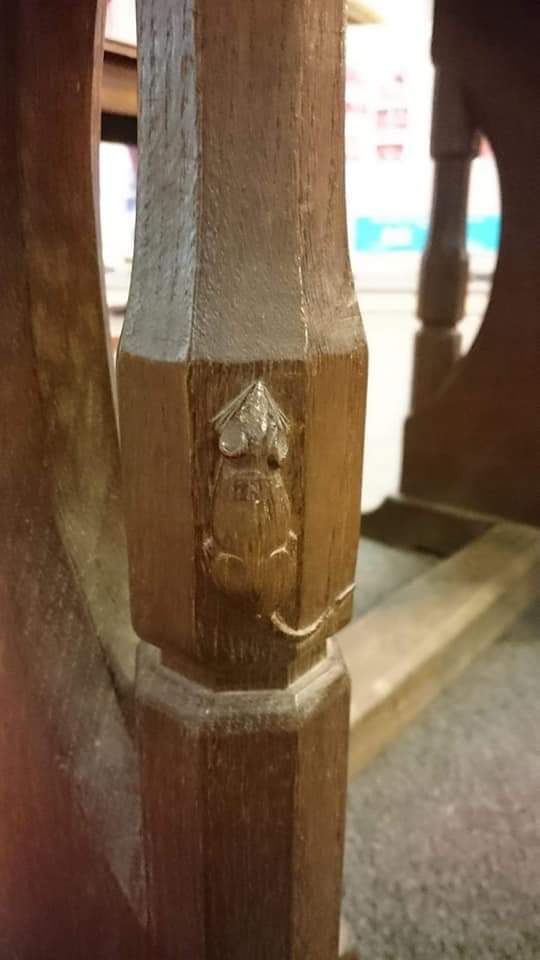


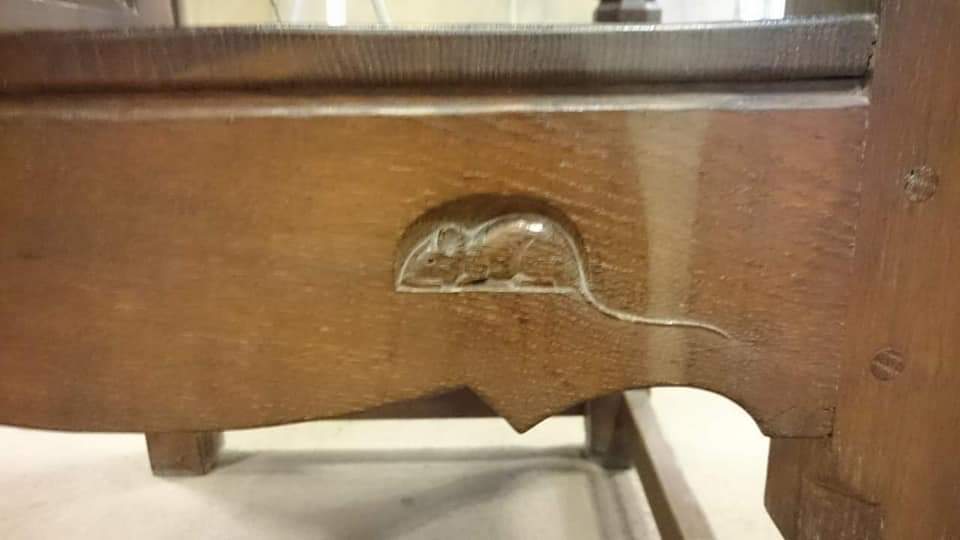
Photos: Author
The Thompson chair at Trinity Church is dedicated to Augusta (née Whitehead) and Henry Cowper Cradock who married on November 1 1893 at St Mary’s in Mirfield. Their daughter Aline Mary Cradock was born on June 18 1905 in Ossett. Henry was the Vicar of Ossett from 1893 to 1909 and they lived at the Vicarage on Dale Street.
Augusta became famous for her children’s books about Josephine. Under the name of Mrs HC Cradock, she had great success and her published work included: The Care of Babies, a Reading Book for Girls (1908), The Training of Children from Cradle to School, a Guide for Young Mothers, Teachers & Nurses. But it was Augusta’s tales of Josephine which gave her the most success.
In 1927 Henry retired to Middlesex where he died on July 6 1933 at his home, 48 Sydney Grove, Hendon. Augusta died on October 19 1941, in Dorking.
JOSEPH WALKER – The first Vicar of Gawthorpe
©️ Anne-Marie Fawcett
In January 1895 Joseph Walker, curate of Outwood, was appointed by the Bishop of Wakefield as curate in charge of Gawthorpe. This was prior to the forming of the new parish from parts of the parishes of Holy Trinity, Ossett and St Peter’s, Earlsheaton. He then became vicar designate before becoming the first vicar of Gawthorpe and Chickenley Heath.
The new parish had no church but building one was high on the list of priorities for Rev Walker. However he said he would rather delay its building and instead see the schools improved and brought up to the national standard. A new church would cost £4,000 but the funds required to improve the schools would be much less at £600. £4,000 then would be over £300,000 now whilst £600 was almost £50,000 in today’s values. The reverend threw himself into raising funds for his new parish and almost £8,000 was eventually achieved.

Joseph was born in Thetford, Norfolk in 1862 to school teachers Louisa (née Bowen)and Joseph Beaman Walker. By the age of 18 Joseph too was a teacher, though he had left Norfolk and was living in Scarborough by this time. Joseph snr died in 1886 and the widowed Louisa, with her son Joseph, moved to Outwood, Wakefield.
In 1883 Joseph was ordained a deacon by the Bishop of Ripon, in 1886 he enrolled at the Theological College of Ripon and in 1889 he was ordained a priest by the Bishop of Wakefield. In 1897 Rev Joseph Walker married Edith Middleton at Outwood, St Mary Magdalene. Edith was the daughter of Ann (née Glover)and Edwin Middleton of Wakefield. Going back a couple more generations I found that Edith is descended from John Fawcett (1755-1833) who is a part of my own family tree. Funny where research takes you the further you delve!
Joseph served as curate to the parishioners of Outwood for six years and when he left to take up the appointment at Gawthorpe and Chickenley Heath he was presented with a gold watch, given as a reminder of the hard work he had put into his time in Outwood and to encourage him in the work that was before him. Joseph wasn’t too sure that he’d be up to building a new church, or taking on a brand new parish, but the Bishop of Wakefield had confidence in him and so it was that Joseph Walker became the first vicar of the new parish of Gawthorpe and Chickenley Heath. Costing almost £5,000 (over £390,000 today), Gawthorpe St Mary the Virgin opened in 1899 close to the western boundary of Ossett, between Chickenley Heath and Ossett Street Side.
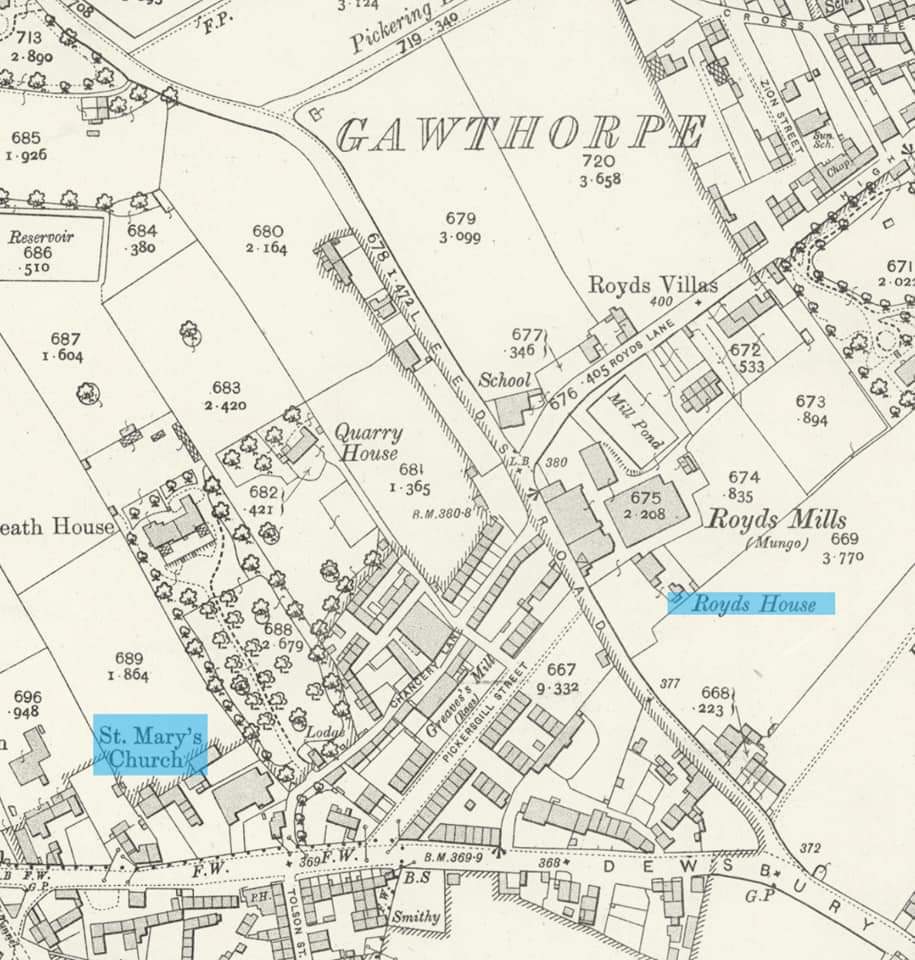
Joseph and Edith lived at Royds House. I’ve included a 1905 map on which we can see where the house was in proximity to the church.
In 1971 many of Gawthorpe’s older properties were removed during the building of the bypass. Was Royds House one of these or did it manage to avoid the wrecking ball? Sadly St Mary’s didn’t and was demolished in January 2011. St Mary’s never had a tower, just the belfry at its east end above the chancel arch. It’s bell was saved and, along with some of the congregation, it was rehomed at Holy Trinity Church.
The irony is that the new parish had been formed, and St Mary’s built, due (in part) to the amount of parishioners at Holy Trinity. Little more than a hundred years later the congregation of St Mary’s had reduced significantly. The Walkers moved on from Gawthorpe in 1903 when Joseph was offered the living (with an eleven roomed vicarage)at Whitley Lower Parish Church in recognition of his hard work.
Shortly after the outbreak of WW1 in 1914 Joseph was succeeded at Whitley Lower by Rev HC Cradock. Joseph was appointed to the parish church of Alverthorpe where he stayed until his retirement in September 1936 at the age of 74.
I can find no further record of Joseph. I found Edith, a widow, in 1939 in Southend on Sea and I wondered if it’s where they retired to. The house was called ‘Whitley’. Living with her was another ‘Edith Walker’ born in October 1893. I was puzzled at first as the Walkers appear to have had no children of their own and they married in 1897. Further investigation revealed that this Edith had been a servant at the vicarage in Whitley. Or was she? Another mystery.
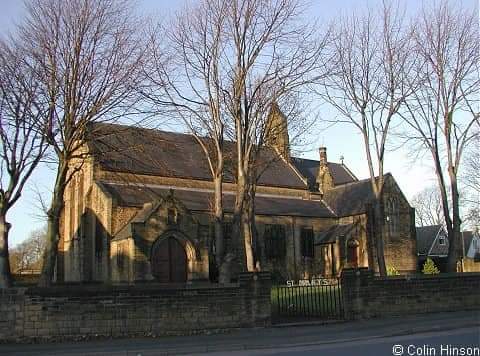
The Church of Gawthorpe St Mary the Virgin was built in 1899. It closed in 2002, largely because of diminishing congregations and a new road layout making access difficult for pedestrians.
In 2007 planning permission was granted to convert the old church into a modern apartment block but this was deferred and the church stood empty for four more years. The fine old church was eventually demolished in January 2011 to make way for residential housing.
The parish of Ossett & Gawthorpe was formed in 2002 with the amalgamation of Holy Trinity, Ossett and St Mary’s, Gawthorpe and Chickenley Heath and it was decided to adopt a new ‘working title’ to reflect the coming together of the two congregations. Trinity Church was decided upon, named after the church which was situated in Ossett town centre almost a century and a half earlier.
 HORBURY & OSSETT FAMILY & LOCAL HISTORY