The following is a vivid and detailed account of personal experiences during a wartime air raid on Ossett, supported by historical newspaper clippings and photographs from Ossett Through The Ages (OTTA).
During the wartime air raid on Ossett in September 1940, the town experienced a bombardment of high explosive and incendiary bombs. Miraculously, there were no casualties despite extensive damage to properties and infrastructure. The attack led to incredible displays of calmness and fortitude among the residents. The defence services responded effectively, and the town rose resilient in the face of adversity.
WAR TIME RECOLLECTIONS
When war broke out in the summer of 1939 I had just celebrated my sixth birthday. I remember clearly several local war events. The one event I remember most graphically was the evening of September 16th 1940, which was Ossett’s only Air-raid.
It was said at the time that it may have been the result of a stray German bomber escaping from a raid on a nearby city. There was the noise of a second plane some minutes later which neighbours claimed to be a Spitfire fighter plane. But before the Spitfire passed over, our only downstairs room and the single upstairs bedroom were bomb-blasted.

Earlier that evening the downstairs room-cum-kitchen had been tranquil. We had placed the black, homemade shutter squares over the windows as darkness fell. My father sat reading. My mother giving me a good soaping as I sat on the draining board, with my feet in the sink. The solid stone wall in front of me saved me from the high explosive blast that was to come. A piercing scream overhead, prompting my father to shout “it’s a bomb” led my mother to run to the wireless (radio) to switch it off! My father dived under the long pine table under the window.
The explosion created utter darkness and the spots of dirt I felt on my nude body were later revealed to be soot spewed out from the old iron fireplace and giving a light coating over all the room. When later cleaning up by candle light, we found, under the pine table, a piece of metal of half inch thick, the size of a mans hand. It was too hot to pick up.
When dawn broke we looked out from our glassless window and saw the devastation.
Forty yards away there was a long gap where the over-grown hawthorn hedge had been. The farmers large hen huts were missing and from the further side of the hedge there was a scattering of feathers and poultry parts. Further away, our neighbours workshop showed signs of the devastation. Just beyond this the two long rows of houses in Hope Street had lost all their windows, upstairs and downstairs, some with curtains waving on the outside. It was the same for houses at a greater distance and some in Manor Road.

From the Ossett Observer September 1940. “I received this model spitfire (on my lapel) at the site of the 10th high explosive bomb dropped on Ossett on 16th September, 1940. I gave a donation to go into Mr. Brear’s garden, which was “L” shaped and wrapped round the front of our garden. We lived next door and were nearest to the blast. I gave a donation to receive the Dinky model Spitfire, as many people did, as they observed the crator.”
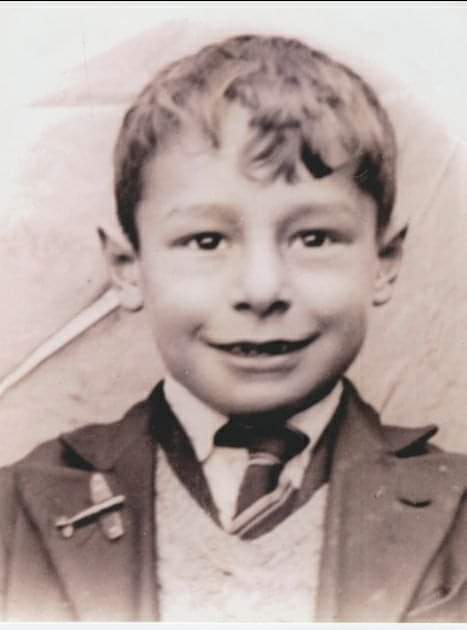
The line of ten high explosive bombs that landed in Ossett landed between the houses. Additionally, approximately twenty incendiary bombs drifted into Gawthorpe and Flushdyke yet no one was killed and there was very little report of injury. Local people said it was a miracle. I think it was in thankfulness for this that our neighbour opened his damaged garden in aid of the war effort. At his gate a gift was given (I think it was for “Wings for Victory”) and in return a tiny painted metal spitfire was received. I went to visit the crater and received this replica. I still have a 1940’s photograph with the Spitfire pinned to my lapel.
The bombing on Ossett was not enough to keep us away from school. We were quickly back to Southdale School, where I learnt that two classmates were out, and near where a bomb dropped. All the class and I think all the school that morning had experiences to talk about but the most spectactular was Gerald Stephenson’s story; he was blasted into a dustbin, with few ill effects.

To expand on the Gerald Stephenson story, the second boy was Trevor Senior, my uncle. He was blown over the wall at Queens Terrace (also known as Monkey Terrace). This photo is of no.2 Queens Terrace with Trevor Senior stood by the re-built wall. He is alive and well, living in Birmingham.
Simon Fenech Ossett Through The Ages 2017
My wife’s great grandad began the plumbing business of J A Fawcett (Joseph Arthur Fawcett). His workshop was next to the railway bridge at the top end of the Green. His son, Henry Rowland Fawcett, made a large dolls house for my wife Olive which was “split in two” (her words) with the blast. It was in the nearby house where the Fawcett’s lived. Their telephone number was Ossett 20. Mr Horsnell’s was Ossett 21. May I finally add that Mr Fawcett did major work when the underground toilets were constructed in the Town Hall square. These were demolished after the war but a wall tile was recovered with the name J A Fawcett glazed on it.

I have been told that high explosive bomb no. four hit Dr Stoker’s hen hut. Whilst other old houses at the entrance to Manor Lane have, since the war, been demolished, the house written about here remains. (2005).
Photo donated to OTTA by Dr.Stoker.
In our small yard at the house (mentioned above) we erected our own Anderson (I think they named it?) shelter. One of my war-time experiences was to watch the Home Guard Unit practising manoeuvers in the Manor Road Recreation Ground. They would sometimes crawl over the ground. I remember a compassionate, loud speaking officer instructing an older member of the Home Guard who found it difficult to manoeuver in this way.


The streets, of necessity, were dimly lit. I would go to the Palladium cinema, in the centre of Ossett to see the big film and the war reports. Afterwards I would call in at the “Cabin” or the “Nip in” fish/chip shops.

At Southdale School I had a friend named Michael who was an evacuee from the South Coast. One day he told me that he and his family lived in the smallest home in Greatfield Road. It was the two storey annex of a large house which was divided up. Not long ago Michael returned to see the house.

The sirens sounded occasionally. There were the “buzzers” of the woollen mill and pits. Following 1941 we had an official leather bag into which we put my baby sister for protection. Then we pumped in air. The bag was used on one occasion only.
Early in the war it was decided by the Authorities that children should attend a school very near their home. Then there was the possibility of returning home when the air-raid siren sounded. I then attended Southdale School which was almost a mile distance. I was, therefore, directed to attend a new war time school which was set up in the now demolished Trinity Methodist Church on South Parade. We were given a test to see how long it took to run from Trinity to our homes. Then the times were given to the teachers. My good friend Ken who was one year older and lived in Hope Street, took a longer time for the run. If I remember correctly, because of the times, I had to attend Trinity School and Ken was excused. The Trinity School experiment lasted only a short time, there were difficulties for teachers and scholars. Soon, I returned to Southdale and Ken returned to Spa Street School. There were occasional air-raids on both nearby Wakefield and Dewsbury, and each town had its bomb victims.
I experienced the beginning and the ending of the 1939-45 war in my Ossett situation. The war began for me, not via a wireless broadcast, but when a large aircraft flew very low on the western side of Ossett. I saw the ‘plane flamed within the posts of our high gate in Manor Lane. It was an unusual sight and indicated that war had begun. I received the news that the war had ended as I walked along Prospect Road in Ossett, with a large basket of bread I had just collected at Oliver Myers’ bakery. I was an errand boy. The mill buzzers began to wail. A passer-by agreed that this must be the end of the war.
King George VI sent A4 size (approx) cardboard sheets to all schoolchildren thanking them for their war effort. Somewhere among my souvenirs I still have the sheet.
Near the end of the war, one of the new pilotless bomber planes was heard by Ossett folk to cut its engines. It glided onto Grange Moor.
I have in my possession five visual aids:-
- The King George VI card
- The 1940’s photo with replica spitfire
- The replica spitfire
- Map of Ossett – September 1940 – bomb placing
- Map of local gardens – Manor Road
One evening our family made our way up a dark drive to a large red-bricked house in Broadowler, Ossett. It was the home of Mr and Mrs Lee. The house still exists today (2005) but has a pinafore of council houses before it, where the dark drive once existed. Mr Lee was an invalid; there was one son Colin and he had six or seven grown sisters. We were going to a party where Mrs Lee directed the games and provided the late dinner. To my childhood surprise there were a goodly number of Ossett based soldiers present. We were entertaining the troops! (To digress, at a large mill half way along Wesley Street, which the Army had commandeered, young men from as far away as Scotland were “kitted out” and received their uniforms).
One game I remember at this very enjoyable party was called “Sunrise”. A large sheet was held vertically by two people in the middle of the room. A person with a lit candle crouched behind the sheet and moved the candle from one lower corner of the sheet diagonally across to the far top corner. The contestants, mainly soldiers, came one by one from another room and were told to closely watch the sunrise. Having arrived at the top of the sheet a water soaked cloth was promptly pushed into their face. I think I can say everyone really enjoyed the party.
Maybe several young men came to Ossett to receive their soldiers kit who were later to become “well known”. One was Godfrey Evans, even then a first class cricketer for Kent, and later for England (v Australia 1948 etc). He went down to the Ossett Cricket Club and was promptly put into the second team. The story, I think, must have some element of truth in it. It would be difficult, in those days, to assess the many strangers at the Cricket Club. We are told he was put into the first team later. Ernest Steel of Derbyshire C.C.C. became a good servant of Ossett C.C. in post war years following his war time service in Ossett.

***[In 1938 The Entertainments National Service Association (ENSA) was formed to provide entertainment to the British Armed Forces.Terry-Thomas signed up in 1939 and was posted to France. In March 1942 he received an official looking envelope containing ‘a cunningly worded invitation to join the Army’. He accepted the call-up, ‘with dignity, if not enthusiasm’, and joined the Signals Corps in Ossett. He said that “it would have seemed rather rude and ungrateful to refuse”. About twenty four hours after his arrival at the barracks, he was asked by a sergeant for his service number. “Mayfair 0736” was his reply. “You ain’t Terry-Thomas any more,” bellowed the sergeant. “You are now just a ******* number!” Terry-Thomas replied, “Yes mate, Number One!”. Within two weeks of his arrival in Ossett he had hired the Town Hall and staged a concert. Despite his bad start at the training depot, Terry-Thomas was actually a good recruit and contemporaries said he sounded more like an officer than the real ones. After basic training he was promoted to the rank of corporal and he applied for a commission but was turned down due to a problem with his hearing. Instead he was offered a place in one of the newly formed services sponsored touring revues – Stars In Battledress. Terry-Thomas continued to appear in cabaret and variety shows while in the army. He finished the war as a sergeant and was finally demobbed on April 1 1946. Oh, I say!]***
The only restaurant in town in those days was “Griffin and Sayers” at the entrance to Kingsway. We would queue at the nearby Co-op shops for our rations, bread, meat etc and go to Bainbridges small shop on the corner of Kingsway for our ration of sweets.
I remember my father telling me that Lord Haw-Haw used to broadcast from Germany to British people, and said that German aircraft were going to bomb Ossett as they knew it was a garrison town and that they knew that aircraft parts were made in the town. My dad also told me about an incendiary bomb that fell in Trinity churchyard. He said Bill Smith who lived three houses down from him in Springstone Avenue, jumped over the church wall and tried to smother it with his overcoat but it didn`t work, so ran back home and got a spade. When I was 12 year old I was riding a bike around old crownland pit spoil heap at the top of Crownlands lane. I climbed over an old stone wall into a small field that was next to Kingsway and found a metal object about 15inch long in the field. I took it to Allan Spurr who lived just down the lane, and he told me it looked like a small shell or bomb, so I got on my bike and took it down to the police station, went in and knocked on the sliding window. The window opened I put it on the counter and said: “I’ve found a bomb.” The bobby said “what makes you think its a bomb?”, so I said Allan Spurr told me it was, and he took 3 steps back, then got a bucket of sand and put the bomb in. I had to show them where I found it. Three weeks later I got a receipt from the army bomb disposal team saying that it was an incendiary bomb, probably German WW2 and they had dealt with it.
Stuart Ibbotson 2017
NAZI RAVAGES IN NORTH EAST TOWN MARVELLOUS ESCAPES FROM DAMAGE AND INJURY
THE OBSERVER SATURDAY SEPTEMBER 21 1940

What is officially described as a north eastern town received its first baptism from the air on Monday evening in the shape of a veritable downpour of incendiary and high explosive bombs, all within a comparatively limited area. The momentary effect was almost stupefying, but alarm immediately gave way to an amazing display of calmness and fortitude, not a single instance of panic being reported from any part of the borough.
The attack was heralded by a long piercing wail, followed by a terrific explosion. Our representative was at that moment attending a meeting of the local authority at the Town Hall, which was immediately suspended unceremoniously, members and officials hurrying into the market square, into which the patrons of the local cinema were rushing en route to shelter and their homes. In the meantime several other explosions were heard and the fleeing pedestrians took advantage of the underground school shelters en route, which proved a welcome and timely refuge. The fact that the town contains about a score of uncompleted shelters, all roofless, and waiting for months for the necessary material to finish the work, was a matter for severe criticism and one which the local authority should take up without further delay. Those available were taxed to the utmost, and it was fortunate the school shelters had been allotted to the public use.
ONE ‘ PLANE OR TWO? There seems to be a difference of opinion as to whether one or two enemy planes delivered the attack. It is believed by those in the best position to judge that only one was operating and that it’s course was practically from due west to due east, ejecting 20 to 30 incendiary bombs from the side, which were carried by a strong breeze about a mile to the east and fell almost in a direct line from a colliery in the northern part of the borough to the boundary of a neighbouring city. The high explosives, which apparently fell almost vertically, were ten in number, all of about two cwt. calibre, and these were also in an almost direct line, for a distance of about half to three quarters of a mile as the crow flies.
The first high explosive dropped in a garden against the cricket ground, the second on a lawn in a nearby terrace, the third on the exterior premises of a well known plumber, the fourth across the road in the grounds of a local doctor, against his private underground shelter, the fifth and sixth in a field over the brow about 200 yards away, the seventh in an adjacent allotment, the eighth about 300 yards farther on at the entrance to a nursery, the ninth 200 yards lower down by the pavement side against a mill entrance, and the tenth and last about 300 yards farther still in the garden of a house abutting a main road running to an old time spa. It was reported to the authorities that another, apparently unexploded, had buried itself in the back garden of a bungalow situate in a well known drive, but expert examination the following morning proved that the fears were unfounded, and that the soil disturbance was purely superficial and due to some other cause.
NO DIRECT HITS The amazing thing about the high explosive bombs is that, although they all fell in close proximity to residences, some in fairly thickly populated localities, there was not a single direct hit. Another fortunate circumstance was that the much abused heavy, sticky clay with which the line of attack abounds, absorbed the shells, retaining nearly the whole of the jagged and murderous looking fragments, and releasing little more than the blast, which was responsible for practically the whole of the damaged windows and outbuildings. The astounding manner in which the craters are dotted in open spaces between the various houses, and that not a single person was injured, points to an escape which can only be described as providential and for which the inhabitants generally have a great deal to be devoutly thankful.
A few details of the effects of the individual bombshell be of interest. To return to No.1 bomb – that which fell at the bottom of a builder’s garden near the cricket ground – part of a brick wall and wooden fence were broken and several shrubs and plants were uprooted. A few feet from the craters, part of the framework of a rose pergola was torn away, but the flower beds adjoining were only slightly affected.
HURLED IN DUST-BIN No.2 fell in the terrace a short distance from the first, less than a yard from the front door, causing a large crater and breaking down part of a brick wall. Not a single window was damaged, but the cellar walls were slightly bulged and plaster knocked off from the ceiling. The occupants, Mr and Mrs Stephenson and their family, were evacuated until the house could be inspected and rendered safe for habitation. Two eight year old boys, Trevor Senior and Gerald Stephenson, were playing in the garden at the time, and the blast from the bomb hurled Gerald head first into an open dustbin, while his companion was thrown over the wall and partly buried by the debris. Both escaped with bruises and slight shock.The third hit a warehouse in the occupation of Mr Fawcett, plumber, almost completely wrecking it. It was an old stone building, formerly used as stables. The bomb just missed Mr Fawcett’s house, which is close by. The damage to the stock, which consisted of earthenware, lead pipes, cast iron spouting, families, hot water pipes and fittings, plate glass, three bicycles, paint, plaster and tools, is estimated at £130. On the other side of the road, but about 100 yards lower down, is the doctor’s garden in which the fourth was dumped. A big disturbance of the soil is to be seen, but apart from a cracked window or two there is little damage.
GARDEN AND WINDOWS DAMAGED Proceeding up the slope from the garden brings us across a small field to the land purchased by the corporation for a central school. Here, against the council school garden and just inside a hedge, was found a small hole caused by bomb No.5. The expert of the Royal Engineers who located it on Tuesday morning soon ascertained, by the use of a spade, that the heavy bed of plastic clay beneath contained large chunks of shell, very little of the metal having escaped from the earth. On the other side of the hedge, and just across a cul de sac lane are four large residences. The first and second, occupied respectively by Mr Nettleton and Mr Cockburn, felt the full effects of the blast, but, although the structures remained almost unimpaired except for shrapnel and gravel marks, windows were blown clean out along both fronts, and shelter was obtained elsewhere. Windows in the homes of Mrs Senior and Mr Smith were also cracked. To the right of the line from the doctor’s to this point, and about 150 yards away, was a large crater in the middle of the same ploughed field, denoting the resting place of bomb No.6, and a little distance away and over the wall in the allotment alongside station road was the seventh. The upheaval was exceptional and the unfortunate tenant has to deplore the loss of a goodly portion of his produce. Close by runs a length row of house, but curiously enough, while only two windows in this row were broken, many of the front windows of the same street on the other side were smashed. The near side row of houses had afforded them no protection, the blast apparently taking a switch back route over the near houses and down into the street on the other side. Coming from the allotments into the station road and moving southwards, one noticed an occasional cracked window, but the presence of large quantities of soot in the interiors was indicative of considerable vibratory effects. Quite a short distance down the road is a turn to the left into what is known as a square and on the right hand side just inside the entrance gate to a nursery are to be seen the ravages of the eighth visitant, which vented its spleen on the clay bed beneath, and a few shrubs and trees alongside.
A NARROW ESCAPE On the opposite side of the narrow road is a continuous row of houses, yet not a pane of glass is displaced or damaged. The tenants had a remarkable escape and can attribute their immunity from harm to the adhesive nature of the earth. About 200 yards round the corner and alongside the left hand side causeway near a mill entrance is the ninth cavity. A preliminary examination after dark led to the belief that the bomb had not exploded and safety first methods were at once adopted. Houses on the other side of the road, but 30 or 40 yards away, and a number adjoining in a small side street, had windows blown in, and those in close proximity to the danger were evacuated for the night. Exactly across the road from the crater is a wall with a belt of trees enclosing the grounds and residence of Miss Scott. All the windows were smashed, coping stones on the wall were hurled onto the lawn, branches of trees were broken off, telephone wires were brought down and shrapnel marks pitted the stone work. Miss Scott and her household staff were housed by friends. Near to the scene lie a few humble cottages, the windows of which were cut out cleanly as if removed by a diamond. These tenants were also removed. Behind them and up to the station road are to be seen a few houses with damaged windows, a similar result being noticeable in the civilian casualty station close to. Only one patient had been treated at the station – for shock – and in view of the suspicion with regard to the bomb the staff afterwards repaired to the town hall, where temporary arrangements for treatment, if necessary, were made. The following morning it was proved conclusively that bomb No.9 had exploded.
FOWLS KILLED Most damage was caused by the tenth and last high explosive bomb, which fell in the garden of Mr Brear, about 150 yards below No.9. It penetrated six inches of concrete and a similar thickness of solid stone, causing a large crater to be formed and shrapnel and fragments to be hurled for a considerable distance. Practically every window in two neighbouring streets, consisting of 30 houses, were shattered, and the house on the main road on either side of Mr Brear’s, and two shops, were similarly affected. Two brick built poultry house owned by Mr Brear, which had only been up for a fortnight, were completely wrecked and eight or nine fowls killed. A hole had been made in in the corrugated iron roof of a garage and workshop, and also in the side of a caravan inside the building. The house and cottage adjoining, occupied by Mr and Mrs Tasked, had all their windows broken. Mr and Mrs Brear were out at the time of the explosion, but their three children were in the house, yet escaped injury, although some damage was done to carpets and furniture. The children immediately went down into the cellar. In the garden fruit trees were prematurely pruned and a greenhose badly damaged. The following morning most of the residents in the vicinity were engaged in nailing up pieces of oilcloth and sacking, and making amateur shutters to cover their gaping windows. Despite the inconvenience caused, particularly in the game which raged throughout the day, they took the damage philosophically, and even made jokes about it. Mr Brear’s children showed their enterprise by inviting the general public to see the damage, the fee being a subscription to the Spitfire fund. Two collecting boxes had been filled at the end of the first day.The same bomb also caused serious damage to poultry huts in a field adjoining Mr Brear’s house, owned by Mr J Crossland, and killed many of his fowls. Five huts, including one fairly new, measuring 30 feet by 12 feet and costing £40, were almost completely wrecked and a large number of the 100 or so fowls they contained were killed or missing, their disembowelled bodies having been flung all over the field. Mr Crossland estimates the damage at £60 at least. Within a small radius of this crater, over 200 windows were broken. Fireplaces were choked up with soot, and one tenant had the door lock displaced and the spectacles blown from her face.
MOTHER’S PRESENCE OF MIND Among the many incidents recorded is the outstanding example of coolness and presence of mind in the station road, near the entrance to the allotments. A woman was seen pushing a perambulator, containing her baby, along the footpath, and immediately the aerial screech was heard, she placed the child on the pavement against the wall side, covered it with a pillow, and lay down next to it. When the danger had passed, she calmly replaced the child in the pram and continued her journey as if nothing had happened. This is the spirit which was very general in the town that evening, particularly after a short reflection, and indicates the grim determination of this section of the Empire, in common with others, to present a stiff upper lip to the intimidatory attempts of the Nazi regime.
As we stated, the evacuated tenants near bomb No.9 were housed with friends, as also were several people in the neighbourhood of bombs 1,2 and 3, concerning one of which there was some uncertainty. Seventy nine other persons were removed to chapel premises in a locality known as The Common, and which had been earmarked by the authorities for such purposes. Here they were housed for the night, and were regaled with hot drinks and food until noon the following day, when the expert proclaimed their district to be safe, and they all returned to their homes.
LINE OF INCENDIARIES As previously stated, the incendiary bombs – the exact number is unknown, probably between 20 and 30 – fell in a parallel line to the high explosive bomb route, a mile away on the north side. Marvellous to relate, these also failed to secure a direct hit (with one exception, in which case the roof of a house tenants by an ex attendance officer received a glancing blow), though some of them dropped perilously near important buildings and houses. The prompt and effective manner in which they were dealt with by wardens and others was a revelation, and within a very short time all danger was removed. A vicar, who had charge of a warden’s post, took out a party which dealt with no fewer than five, one which fell a few yards from the cast end of the parish church, a second in the vicarage field, a third near an old destructor works, a fourth in a recreation ground, and a fifth on a space between the houses of an adjacent street. One which flopped in a main road in the North Ward was kicked into the roadside ditch by a cool headed bus inspector who was standing by. Near the same main road, half a mile lower down, is a working men’s club, in which the committee were holding their weekly meeting. A brilliant light suddenly illuminated the football ground at the rear, and the committee at once rushed to the spot, ascertaining the cause, and by the use of sods which had been removed for relaying purposes, quickly extinguished it. Some boys pluckily dealt in a similar way with incendiaries which fell in a field near a railway bridge, and there are other instances of effective action by wardens and civilians along the line of attack.
THE DEFENCE SERVICES The whole of the defence services of the town responded splendidly – wardens, first aid workers, decontamination and rescue squads, AFS, special constables(who were on duty the greater part of the night guarding essential spots, as well as the following day), motor drivers, messengers, the whole of the personnel in fact – a tribute to the growing efficiency of the workers and their zeal and readiness for action in the hour of trial.To the regular police also, and their ubiquitous inspector, who were indefatigable in their efforts to safeguard the inhabitants generally, the public thanks are due. Since the event, hundreds of people from neighbouring districts have visited the town and made an inspection of the craters and damage.Dr John Stoker, son of Dr Stephen Brandon Stoker whose GP Practice was at Sowood House has very kindly provided the attached photographs of some of the bomb damage. The bomb just missed Sowood House where the Stoker family lived. Dr John simply states that “We were asleep in bed in the cellar and didn’t know anything about it until morning!”
The Ossett Observer of September 2nd 1939
The following cellars in the town centre will be public shelters for the accommodation of those persons caught in the streets by an air raid:

- The public library
- The Liberal Club
- Ossett Industrial Co-Operative Society (drapery department)
- Ossett Industrial Co-Operative Society (furnishing department)
- The Horse & Jockey Hotel
- The Royal Hotel
- The Carpenters Arms
- The Cock & Bottle
- The Trades & Labour Club
- The George Hotel
- The Great Northern Hotel
- Ossett Insustrial Co-Operative Society (Streetside)
- The Old Flying Horse Hotel
- The Red Lion Hotel
- The Commercial Inn

Ossett Observer November 25 1939. Certain basements in the town were strengthened to serve as public shelters. This was the cellar of Ossett Liberal Club, specially fitted with seats and toilets, stated to be capable of accomodating at least 70 people. With S F Armitage (my dad).
Jennifer Bragg
The first warning of an impending air raid will be an intermittent blast sounded on the sirens in the town, which will no longer be used for industrial purposes. If gas is used, special warning will be given by the Air Raid Wardens and Special Constables by the sounding of hand rattles. When the gas has cleared hand bells will be sounded. When the raiders have passed a continuous blast will be sounded on the sirens. When the sirens are sounded all persons within 5 – 10 minutes of their homes are recommended to go there.
 HORBURY & OSSETT FAMILY & LOCAL HISTORY
You must be logged in to post a comment.